MCQ
Which of the following cannot travel in vacuum?
  • A
    Radio waves
  • B
    Gamma Waves
  • C
    Infrared Waves
  • Infrasonic waves

Answer

Correct option: D.
Infrasonic waves

Radio waves, gamma waves, and infrared waves are electromagnetic waves and due to this they do not need any material medium to travel and hence, can travel in vacuum. Whereas, infrasonic waves are mechanical waves and so, they need a material medium to travel. Therefore, infrasonic waves cannot travel in vacuum.

Need a full question paper?

Generate a complete, print-ready paper with questions like this in minutes — across 16+ boards, with answer keys.
Start Generating Free

Similar questions

In Young's double slit experiment the separation $d$ between the slits is $2\,\, mm,$ the wavelength $\lambda$ of the light used is $5896 Å $  and distance $D$ between the screen and slits is $100\,\, cm.$ It is found that the angular width of the fringes is $0.20^o $ . To increase the fringe angular width to $0.21 ^o $ (with same $\lambda$ and $D$) the separation between the slits needs to be changed to ......$mm$
A parallel plate air capacitor is charged to a potential difference of V. After disconnecting the battery, distance between the plates of the capacitor is increased using an insulating handle. As a result, the potential difference between the plates
Three capacitors of $2\,\mu F,\,3\,\mu F$ and $6\,\mu F$ are joined in series and the combination is charged by means of a $24\, volt$ battery. The potential difference between the plates of the $6\,\mu F$ capacitor is.......$volt$
The dielectric strength of a medium is $2 kV mm ^{-1}$ What is the maximum potential difference that can be established across a $50 \mu m$ sample without binding?
A capacitor is a perfect insulator for
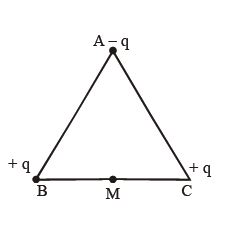
Charges $-q,\, q,\,q$ are placed at the vertices $A$, $B$, $C$ respectively of an equilateral triangle of side $'a'$ as shown in the figure. If charge $-q$ is released keeping remaining two charges fixed, then the kinetic energy of charge $(-q)$ at the instant when it passes through the mid point $M$ of side $BC$ is 
Which of the following particle will experience maximum acceleration when projected with same speed in transverse magnetic field
Magnetic lines of force:
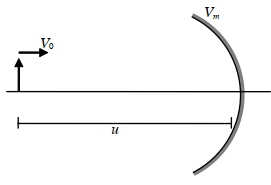
An object and a concave mirror of focal length $f=10 cm$ both move along the principal axis of the mirror with constant speeds. The object moves with speed $V_0=15 cm s ^{-1}$ towards the mirror with respect to a laboratory frame. The distance between the object and the mirror at a given moment is denoted by $u$. When $u=30 cm$, the speed of the mirror $V_m$ is such that the image is instantaneously at rest with respect to the laboratory frame, and the object forms a real image. The magnitude of $V_m$ is. . . . . $cm s ^{-1}$.
Which of the following is the correct definition of ampere?