MCQ
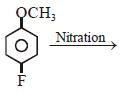
Which of the following carbocation will undergo rearrangement ?
  • A


  • C
    $\begin{matrix}
       C{{H}_{3}}-CH-{}^{\oplus }C=O  \\
       |\,\,\,\,\,\,\,\,\,\,\,\,  \\
       C{{H}_{3}}\,\,\,\,\,\,\,  \\
    \end{matrix}$
  • D
    $\begin{matrix}
       C{{H}_{3}}-NH-{}^{\oplus }CH-CH-C{{H}_{3}}  \\
       \,\,\,\,\,\,\,\,\,\,\,\,\,\,\,\,\,\,\,\,\,\,\,\,\,\,\,\,\,\,\,|  \\
       \,\,\,\,\,\,\,\,\,\,\,\,\,\,\,\,\,\,\,\,\,\,\,\,\,\,\,\,\,\,\,\,\,\,\,\,C{{H}_{3}}  \\
    \end{matrix}$
Answer

Correct option: B.

b
$(b)$ For each carbocation rearrangement there must be some driving force. Carbocation rearranges only when more stable carbocation is formed.

Need a full question paper?

Generate a complete, print-ready paper with questions like this in minutes — across 16+ boards, with answer keys.

Start Generating Free

Similar questions

Consider the cell $Pt|H_2(P_1\ atm) | H^+(X_1M) || H^+ (X_2M) | H_2(P_2\ atm) |Pt.$ The cell reaction will be spontaneous if 
Which of the following is least reactive towards $SN^{Ar}$
Consider the following complex ions, $P, Q$ and $R$.

$P =\left[ FeF _6\right]^{3-}, Q =\left[ V \left( H _2 O \right)_6\right]^{2+} \text { and } R =\left[ Fe \left( H _2 O \right)_6\right]^{2+} \text {. }$

The correct order of the complex ions, according to their spin-only magnetic moment values (in $B.M.$) is


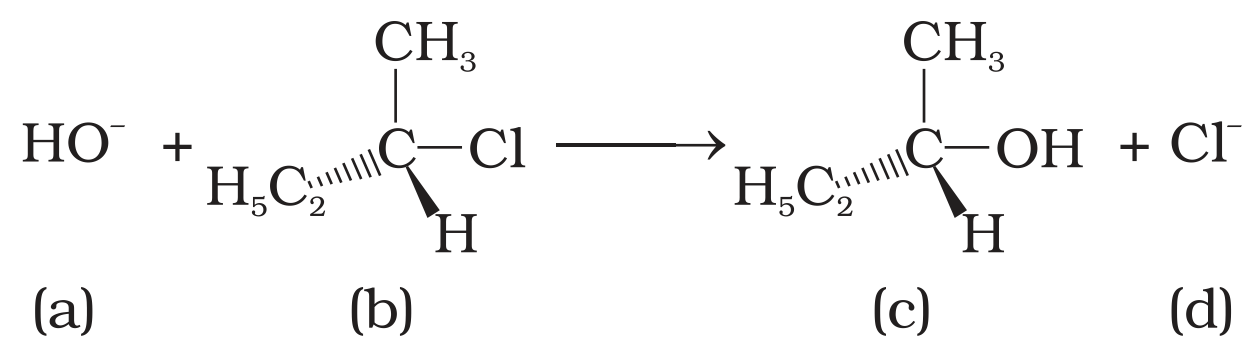
Which of the following statements are correct about the mechanism of this reaction?

Major product
Given 

$F{e^{ + 3}}\left( {aq} \right) + {e^ - } \to F{e^{2 + }}\left( {aq} \right);{E^o} =  + 0.77\,V$

$A{l^{ + 3}}\left( {aq} \right) + 3{e^ - } \to Al\left( s \right);{E^o} =  - 1.66\,V$

$B{r_2}\left( {aq} \right) + 2{e^ - } \to 2B{r^ - };{E^o} =  + 1.09\,V$

Considering the electrode potentials, which of the following represents the correct order of reducing power?

For the following reactions.....$kJ/mol$

$\mathrm{A} \stackrel{700 \mathrm{K}}{\rightarrow}$ Product

$\mathrm{A}\xrightarrow[\text { catalyst }]{500 \mathrm{K}} $ Product

it was found that $\mathrm{E}_{\mathrm{a}}$ is decreased by $30 \;\mathrm{kJ} / \mathrm{mol}$ in the presence of catalyst.

If the rate remains unchanged, the activation energy for catalysed reaction is (Assume pre exponential factor is same $):$

In which case, the order of acidic strength is not correct ?
Which of the following gases are poisonous
Glycogen is a branched chain polymer of alpha-D-glucose units in which chain is formed by C1—C4 glycosidic linkage whereas branching occurs by the formation of C1-C6 glycosidic linkage. Structure of glycogen is similar to __________.