MCQ
Which of the following complexes has maximum $CFSE$?
  • $K _{3}\left[ Fe ( CN )_{6}\right]$
  • B
    $K _{3}\left[ Co ( Ox )_{3}\right]$
  • C
    $K _{3}\left[ CoF _{6}\right]$
  • D
    $K _{3}\left[ Co ( CN )_{6}\right]$

Answer

Correct option: A.
$K _{3}\left[ Fe ( CN )_{6}\right]$
a
In $\left[ Fe ( CN )_{6}\right], Fe ^{3+}, d^{5}$ is low spin and the value of $CFSE$ is

$-2.0 \Delta_{0}$

So, $K _{3}\left[ Fe ( CN )_{6}\right]$ has maximum $CFSE.$

Need a full question paper?

Generate a complete, print-ready paper with questions like this in minutes — across 16+ boards, with answer keys.
Start Generating Free

Similar questions

The rate constant of a reaction at temperature $ 200\,K$ is $10$ times less than the rate constant at $400\,K.$  What is the activation energy $({E_a})$ of the reaction ($R =$  gas constant)
Identify product $( A )$ is the following reaction :
In fructose, the possible optical isomers are
Magnetic moment $2.84\, B.M.$ is given by (At. nos. $Ni = 28, Ti = 22, $$Cr = 24, Co = 27$)
An acidified solution of potassium chromate was layered with an equal volume of amyl alcohol. When it was shaken after the addition of $1 mL$ of $3 \% H _2 O _2$, a blue alcohol layer was obtained. The blue color is due to the formation of a chromium ($VI$) compound ' $X$ '. What is the number of oxygen atoms bonded to chromium through only single bonds in a molecule of $X$ ?
$\mathrm{PCl}_{5}(g) \rightarrow \mathrm{PCl}_{3}(\mathrm{~g})+\mathrm{Cl}_{2}(\mathrm{~g})$

In the above first order reaction the concentration of $\mathrm{PCl}_{5}$ reduces from initial concentration $50\, mol\,\mathrm{L}^{-1}$ to $10\, \mathrm{~mol} \,\mathrm{~L}^{-1}$ in $120\, minutes$ at $300\, \mathrm{~K}$. The rate constant for the reaction at $300\, \mathrm{~K}$ is $\mathrm{X}$ $\times 10^{-2} \mathrm{~min}^{-1}$. The value of $x$ is $......$

$[$ Given $\log 5=0.6989]$
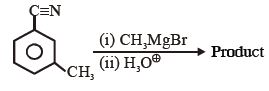
is
From given pair of compounds, in which first will undergo $S_N2$ faster :
The standard electrode potentlal ($E^-$) values of $\mathrm{Al}^{3+} / \mathrm{Al}, \mathrm{Ag}^{+} / \mathrm{Ag}, \mathrm{K}^{+} / \mathrm{K}$ and $\mathrm{Cr}^{3+} / \mathrm{Cr}$ are $-1.66 \;\mathrm{V}, 0.80 \;\mathrm{V}$ $-2.93\; \mathrm{V}$ and $-0.74\; \mathrm{V},$ respectively. The correct decreasing order of reducing power of the metal is
Consider the following reaction,

$3Br_2 + 6CO_3^{2-} + 3H_2O \longrightarrow 5Br^-+ BrO_3^-+ 6HCO_3^-$

Which of the following statements is true regarding this reaction