MCQ
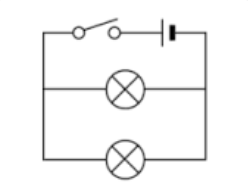
Which of the following component is connected in parallel in the circuit?
  • A
    Rheostat
  • B
    Capacitor
  • Bulb
  • D
    $\text{LED}$

Answer

Correct option: C.
Bulb

Since the current in both bulbs is not same but they have same potential so they are connected in parallel.

Need a full question paper?

Generate a complete, print-ready paper with questions like this in minutes — across 16+ boards, with answer keys.

Start Generating Free

Similar questions

A negative test charge is moving near a long straight wire carrying a current. The force acting on the test charge is parallel to the direction of the current. The motion of the charge is
If an electron revolves around a nucleus in a circular orbit of radius $R$ with frequency $n$, then the magnetic field produced at the centre of the nucleus will be
In the nuclear decay given below 

$_z{X^A}{ \to _{z + 1}}{Y^A}{ \to _{z - 1}}{K^{A - 4}}{ \to _{z - 1}}{K^{A - 4}}$

the particles emitted in the sequence are

The light of wavelength 6328 Å is incident on a slit of width 0.2 mm perpendicularly, the angular width of central maxima will be
A plane convex lens is made of refractive index $1.6$. The radius of curvature of the curved surface is $60 cm. $ The focal length of the lens is.....$cm$
Two opposite charged particles oscillate about their mean equilibrium position in free space, with a frequency of $10^9 \ Hz$. The wavelength of the corresponding electromagnetic wave produced is$..........$
A coil of inductance $2\, H$ having negligible resistance is connected to a source of supply whose voltage is given by $V=3 t$ volt. (where $t$ is in second). If the voltage is applied when $t =0,$ then the energy stored in the coil after $4\, s$ is ............ $J$.
The focal length of the field lens (which is an achromatic combination of two lenses) of telescope is 90 cm. The dispersive powers of the two lenses in the combination are 0.024 and 0.036. The focal lengths of two lenses are
Two identical conducting spheres carrying different charges attract each other with a force $F$ when placed in air medium at a distance $'d'$ apart. The spheres are brought into contact and then taken to their original positions. Now the two spheres repel each other with a force whose magnitude is equal to that of the the initial attractive force. The ratio between initial charges on the spheres is
As the position of an object $(u)$ reflected from a concave mirror is varied, the position of the image $(v)$ also varies. By letting the u changes from $0$ to $ + \infty $ the graph between $v$ versus $u$ will be