MCQ
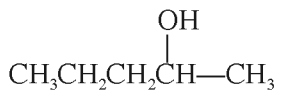
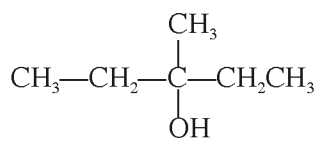
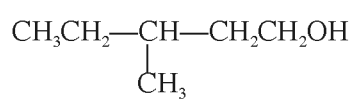
Which of the following compoud will most readily dehydrated?
  • A

    Image
  • B

    Image

  • Image
  • D

    Image

Answer

Correct option: C.

Image
c

Need a full question paper?

Generate a complete, print-ready paper with questions like this in minutes — across 16+ boards, with answer keys.

Start Generating Free

Similar questions

$5$ milli-moles of a solid $A$ was dissolved in $5$ moles of $H_2O$ . On adding to the solvent, $A$  starts polymerising into another insoluble solid following zero order kinetics. On adding $6$ milli-moles of another solid solute $C$ (after $20$ minute) the polymerisation completely stops. The  nsoluble solid polymer is removed and the resulting solution was cooled to a temperature less  than $- 0.186\,^oC$ (melting point of solution) to cause solidification of some liquid water. Calculate the value of $'X'$ if rate constant for polymerisation reaction is represented as $10^{-X}\,moles/minute$ . $[K_f(H_2O) = 1.86\, K\,- Kg\,mole^{-1}]$
Complex compounds $(s)$ which is optical active and does not depend upon the  orientation of the ligands around metal cation :

$(i)\, [CoCl_3 (NH_3)_3]$                           $(ii)\, [Co(en)_3]Cl_3$
$(iii)\, [Co(C_2O_4)_2(NH_3)_2]^-$           $(iv)\, [CrCl_2(NH_3)_2(en)]^+$
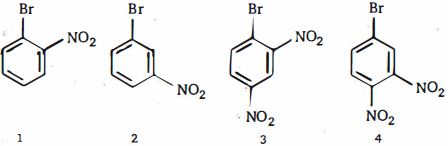
Rank the following in order of decreasing rate of reaction with alkoxide ion $(CH_3 CH_2O^- )$ in a nucleophilic aromatic substitution reaction
Choose the correct option ?
Which is most reactive for nucleophilic addition reaction
An aqueous solution containing $28\%$ by weight of a liquid $A\, (m_w = 140)\, mole$ fraction of liquid is
Which is a common standard for calibrating a bomb calorimeter in teaching laboratories?
Which of the following complexes are homoleptic?
$a.  {\left[\mathrm{Co}\left(\mathrm{NH}_3\right)_6\right]^{3+}} $
$b.  {\left[\mathrm{Co}\left(\mathrm{NH}_3\right)_4 \mathrm{Cl}_2\right]^{+}} $
$c.  {\left[\mathrm{Ni}(\mathrm{CN})_4\right]^{2-}} $
$d.  {\left[\mathrm{Ni}\left(\mathrm{NH}_3\right)_4 \mathrm{Cl}_2\right]} $
Identify $'X'$ in the following sequence of reaction

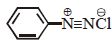
(image) $\xrightarrow[{KCN}]{{CuCN}}P\xrightarrow{{LiAl{H_4}}}Q\xrightarrow{{HN{O_2}}}X$
In an experiment, $1\,g$ of a non-volatile solute was dissolved in $100\,g $ of acetone (mol. mass $= 58$) at $298\,K$. The vapour pressure of the solution was found to be $192.5\,\,mm\,Hg$. The molecular weight of the solute is (vapour pressure of acetone $= 195\,\,mm\,Hg$)