MCQ
Which of the following compound is amphoteric
  • A
    $Cr(OH)_2$
  • B
    $Fe(OH)_2$
  • $Cr(OH)_3$
  • D
    $Fe(OH)_3$

Answer

Correct option: C.
$Cr(OH)_3$
c
Cr$(O H)_{3}$ reacts with bases (hydroxide ions) to give $\left[ Cr ( OH )_{6}\right]^{3-} .$ It also reacts with acids (hydrogen ions) to give $\left[ Cr \left( H _{2} O \right)_{6}\right]^{3+}$

Hence,it act as amphoteric dissolve in both acid and base.

Thus,option C is correct.

Need a full question paper?

Generate a complete, print-ready paper with questions like this in minutes — across 16+ boards, with answer keys.

Start Generating Free

Similar questions

The number of coulombs required for the deposition of $107.870\,g$ of silver is
Hydrogenation of ${C_6}{H_5}CHOH - COOH$ over $Rh - A{l_2}{O_3}$ catalyst in methanol gives
Which of the nitrates on strong heating leaves the metal as the residue
The structures of $O_3$ and $N_3^-$ are
Note: In the following question two or more options may be correct.
Which of the following statements are applicable to a balanced chemical equation of an elementary reaction?
The $'f'$ orbitals are half and completely filled, respectively in lanthanide ions ....

(Given: Atomic no. $Eu, 63; Sm , 62 ; Tm , 69 ; Tb$, $65 ; Yb , 70 ; Dy , 66]$

The rate of reaction between two reactants $A $ and $B$ decreases by a factor of $4$ if the concentration of reactant $B$ is doubled. The order of this reaction with respect to reactant $B$ is
The results given in the below table were obtained during kinetic studies of the following reaction:

$2 A + B \longrightarrow C + D$

Experiment $[ A ] / molL ^{-1}$ $[ B ] / molL ^{-1}$ Initial $rate/molL$ $^{-1}$ $\min ^{-1}$
$I$ $0.1$ $0.1$ $6.00 \times 10^{-3}$
$II$ $0.1$ $0.2$ $2.40 \times 10^{-2}$
$III$ $0.2$ $0.1$ $1.20 \times 10^{-2}$
$IV$ $X$ $0.2$ $7.20 \times 10^{-2}$
$V$ $0.3$ $Y$ $2.88 \times 10^{-1}$

$X$ and $Y$ in the given table are respectively :
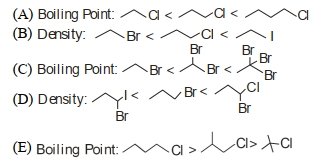
 

Identify the correct order for the given property for following compounds.Choose the correct answer from the option given below :-
Calcium imide on hydrolysis gives gas $(B)$ which on oxidation by bleaching powder gives gas $(C)$ . Gas $(C)$ on reaction with magnesium give compound $(D)$ which on hydrolysis again gas $(B)$ . Identify $(B), (C)$ and $(D)$