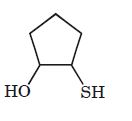
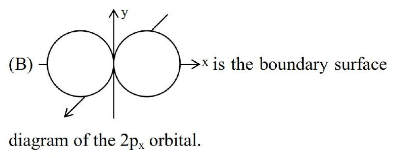
MCQ
Which of the following compound is optically active?
- A
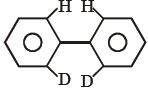
- B
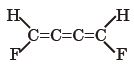
- ✓
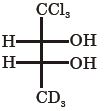
- D
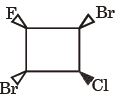
Generate a complete, print-ready paper with questions like this in minutes — across 16+ boards, with answer keys.
$(A)$ $\Lambda \stackrel{0}{ m }$ for electrolyte $A$ is obtained by extrapolation
$(B)$ For electrolyte B, vx $\Lambda m$ vs $\sqrt{ c }$ graph is a straight line with intercept equal to $\Lambda \stackrel{0}{ m }$
$(C)$ At infinite dilution, the value of degree of dissociation approach zero for electrolyte $B$.
$(D)$ $\Lambda \stackrel{0}{ m }$ for any electrolyte $A$ or $B$ can be calculated using $\lambda^{\circ}$ for individual ions.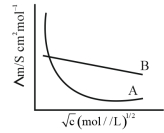
${H_2}O(g){\mkern 1mu} {\mkern 1mu} + {\mkern 1mu} CO{\mkern 1mu} (g){\mkern 1mu} {\mkern 1mu} {\mkern 1mu} \rightleftharpoons \,{H_2}(g)\, + \,C{O_2}(g)\, + \,Heat{\mkern 1mu} {\mkern 1mu} {\mkern 1mu} {\mkern 1mu} $