MCQ
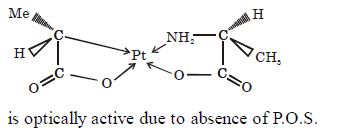
Which of the following compound may show optical activity
  • A
    Trans $[CoCl_2(en)_2]^+$
  • $[Pt(NH_2CH(CH_3)COO)_2^-]$
  • C
    $[Co(H_2O)_3F_3]$
  • D
    All are optically active

Answer

Correct option: B.
$[Pt(NH_2CH(CH_3)COO)_2^-]$
b

Need a full question paper?

Generate a complete, print-ready paper with questions like this in minutes — across 16+ boards, with answer keys.

Start Generating Free

Similar questions

$\mathrm{C}_{6} \mathrm{H}_{5} \mathrm{NO}_{2} \stackrel{\mathrm{Sn}+\mathrm{HCl}}{\longrightarrow}A \,\xrightarrow[\mathrm{{H}^{\oplus}}]{\mathrm{C}_{6} \mathrm{H}_{5} \stackrel{\oplus}{\mathrm{N}}_{2} \stackrel{\Theta}{\mathrm{Cl}}}P$

$\quad\quad\quad\quad\quad\quad\quad\quad\quad\quad\quad\quad\quad$(Yellow coloured compound)

Consider the above reaction, the Product $"P"$ is:

The mixture that forms maximum boiling azeotrope is
Which of following is not correct ?
Arrange the following three chlorides in decreasing order towards $S_{N^1}$ reactivity.
The molality of $90\%$  ${H_2}S{O_4}$ solution is [density $=1.8\,gm/ml$ ]
You have two $C_6H_{10}O$ ketones, $I$ and $II$. Both are optically active, but $I$ is racemized by treatment with acid and $II$ is not. Wolff kishner reduction of both ketones gives the same achiral hydrocarbon, formula $C_6H_{12}$. What reasonable structures may be assigned to $I$ and $II$ respectively ?
Calculate  $E^o_{cell}$  for following cell ............. $\mathrm{V}$

$Zn(s)\,\,|,\,Zn^{+2}_{(aq.)}\,\,|| Ag^+_{(aq.)}\,\,| Ag(s)$

$E^o_{Zn^{+2}/Zn}\,\,=\,-\,0.76V\,\, ;\,\, E^o_{Ag^+ /Ag}\,\, = 0.80V$

Which of the following is not an essential amino acid:
The vapour pressures of $A$ and $B$ at $25^{\circ} \mathrm{C}$ are $90\, \mathrm{~mm}\, \mathrm{Hg}$ and $15\, \mathrm{~mm} \,\mathrm{Hg}$ respectively. If $\mathrm{A}$ and $\mathrm{B}$ are mixed such that the mole fraction of $A$ in the mixture is $0.6$, then the mole fraction of $B$ in the vapour phase is $x \times 10^{-1}$. The value of $x$ is $.....$ (Nearest integer)
The treatment of an ester with $LiAlH_4$ followed by acid hydrolysis produces :