MCQ
Which of the following compounds are gem$-$dihalides?
$a.$ Ethylidene chloride
$b.$ Ethylene dichloride
$c.$ Methylene chloride
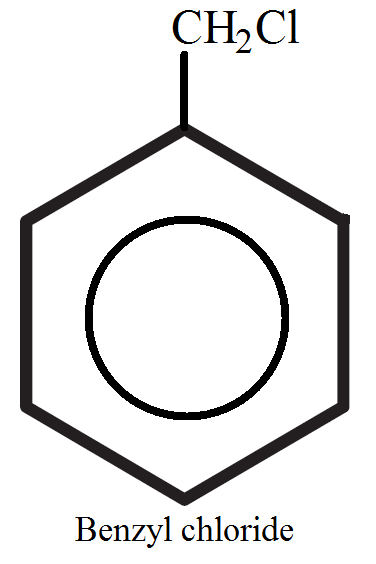
$d.$ Benzyl chloride
  • A
    $a$ and $b$
  • $a$ and $c$
  • C
    $b$ and $c$
  • D
    $a$ and $d$

Answer

Correct option: B.
$a$ and $c$
Gem$-$dihalides are those dihalides in which two halogen atoms are bonded to the same carbon atom.
  1. $\text{Cl}_2-\text{CH}-\text{CH}_3$  Ethylidene chloride
  2. $\text{Cl}-\text{H}_2\text{C}-\text{CH}_2-\text{Cl}$  Ethylene dichloride
  3. $\text{CH}_2\text{Cl}_2$ Methylene chloride
  4.  

So, in $(a)$ and $(c)$ two halogen atoms are present on the same carbon atom and they are termed gem$-$dihalides.

Need a full question paper?

Generate a complete, print-ready paper with questions like this in minutes — across 16+ boards, with answer keys.

Start Generating Free

Similar questions

Which of the following pair gives same phenyl osazone ?
$2\,gm$ of benzoic acid dissolved in $25\,gm$ of benzene shows a depression in freezing point equal to $1.62\ K$ . Molal depression constant for benzene is $4.9\,K\ kg\ mol^{-1}$ . What is $\%$ degree of association of acid
If $E_{{A^{ + 2}}/A}^o =  - 0.30\,V$ and $E_{{A^{ + 3}}/{A^{ + 2}}}^o = 0.40\,V$ the standard $EMF$ of the reaction : $A + 2A^{+3} \to 3A+2$ will be ............ $\mathrm{V}$
Mixture used for the tips of match stick is
In equimolar solution of glucose, $NaCl$ and $BaC{l_2}$, the order of osmotic pressure is as follow
$5$ milli-moles of a solid $A$ was dissolved in $5$ moles of $H_2O$ . On adding to the solvent, $A$  starts polymerising into another insoluble solid following zero order kinetics. On adding $6$ milli-moles of another solid solute $C$ (after $20$ minute) the polymerisation completely stops. The  nsoluble solid polymer is removed and the resulting solution was cooled to a temperature less  than $- 0.186\,^oC$ (melting point of solution) to cause solidification of some liquid water. Calculate the value of $'X'$ if rate constant for polymerisation reaction is represented as $10^{-X}\,moles/minute$ . $[K_f(H_2O) = 1.86\, K\,- Kg\,mole^{-1}]$
Solid $CuSO_4·5H_2O$ having covalent, ionic as well as co-ordinate bonds. Copper atom/ion forms ................. co-ordinate bonds with water.
Which oxide of nitrogen is coloured gas

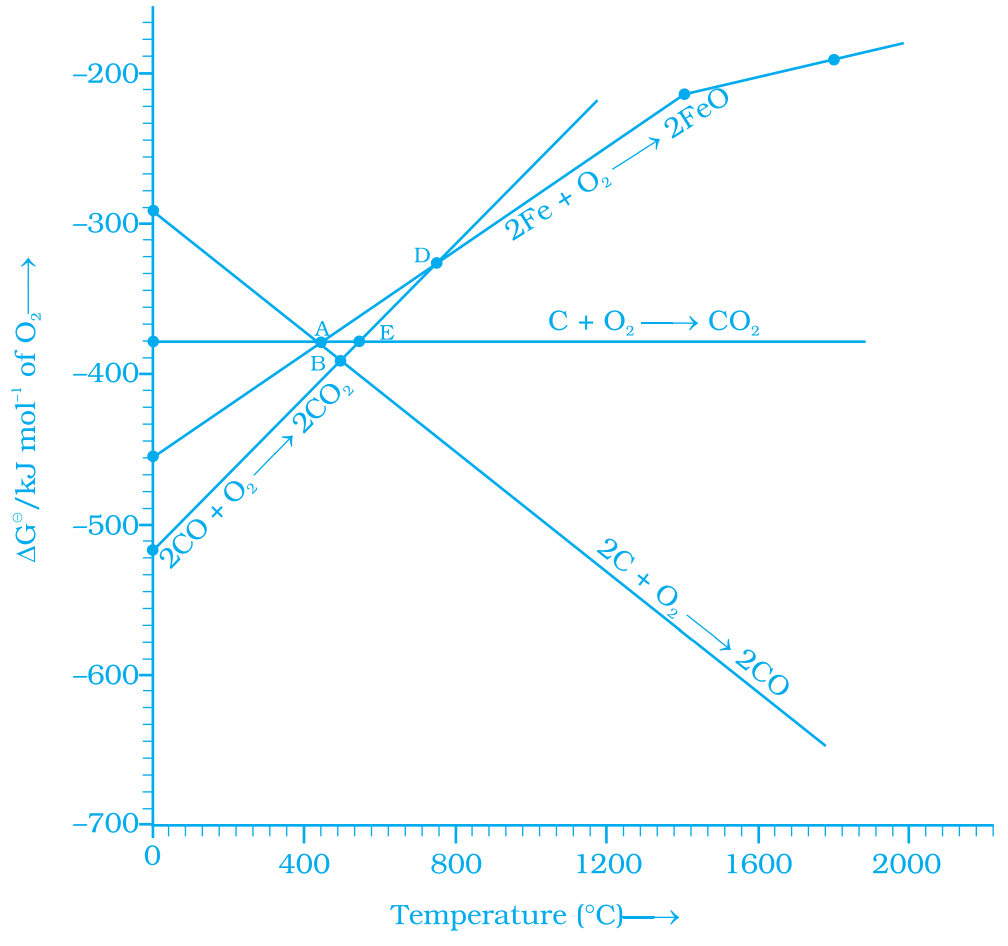
For the reduction of $\text{FeO}$ at the temperature corresponding to point $D,$ which of the following statements is correct?

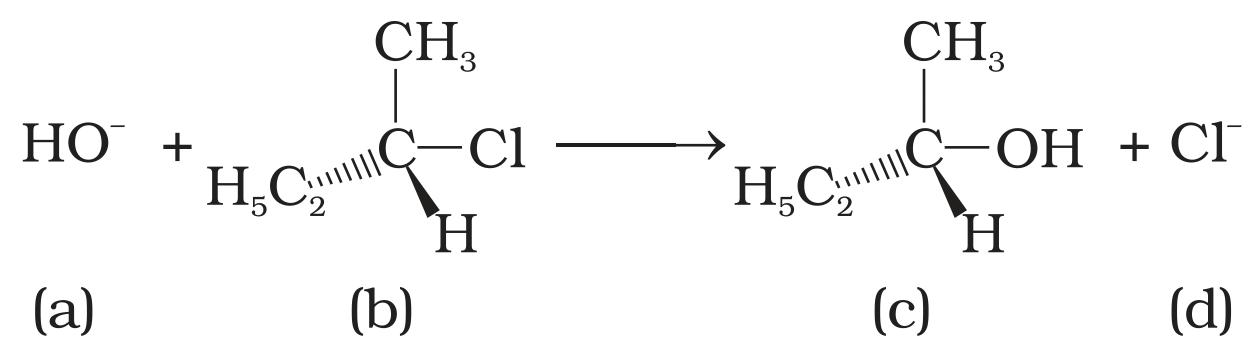
Which of the following statements are correct about the kinetics of this reaction?
$a.$ The rate of reaction depends on the concentration of only $(b).$
$b.$ The rate of reaction depends on concentration of both $(a)$ and $(b).$
$c.$ Molecularity of reaction is one.
$d.$ Molecularity of reaction is two.