MCQ
Which of the following compounds does not react with $NaHSO_3$
  • A
    $C_6H_5CHO$
  • $C_6H_5COCH_3$
  • C
    $CH_3COCH_3$
  • D
    $CH_3CHO$

Answer

Correct option: B.
$C_6H_5COCH_3$
b
Acetophenone $\left( C _6 H _5 COCH _3\right.$ ) does not give addition product with sodium bisulphite $\left( NaHSO _3\right)$ solution. This is because, two bulkier group are attached with the carbonyl carbon. These groups decrease the reactivity of carbonyl carbon.

Need a full question paper?

Generate a complete, print-ready paper with questions like this in minutes — across 16+ boards, with answer keys.

Start Generating Free

Similar questions

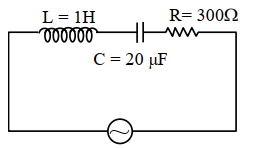
An ac source is connected in given series $LCR$ circuit. The rms potential difference across the capacitor of $20 \mu \mathrm{F}$ is_________.$v$.

$\mathrm{V}=50 \sqrt{2} \sin 100 \mathrm{t}$ volt
For adiabatic processes $\left( {\gamma = \frac{{{C_p}}}{{{C_v}}}} \right)$
A rocket of mass $4000\, kg$ is set for vertical firing. How much gas must be ejected per second so that the rocket may have initial upwards acceleration of magnitude $19.6 m/s^2$. ............... $\mathrm{kg}\, \mathrm{s}^{-1}$    [Exhaust speed of fuel $= 980 m/s$.]
The power of two convex lenses $A$ and $B$ are $8$ diopters and $4$ diopters respectively. If they are to be used as a simple microscope, the magnification of
An electron enters a region where magnetic $(B)$ and electric $(E)$ fields are mutually perpendicular to one another, then
There is rod of length $l$. The velocities of its two ends are $v_1$ and $v_2$ in opposite directions normal to the rod. The distance of the instantaneous axis of rotation from $v_1$ is:
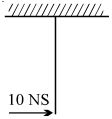
$A$ thin uniform straight rod of mass $2\, kg$ and length $1\, m$ is free to rotate about its upper end when at rest. It receives an impulsive blow of $10\, Ns$ at its lowest point, normal to its length as shown in figure. The kinetic energy of rod just after impact is ........ $J$
Consider telecommunication through optical fibres. Which of the following statements is not true
Find moment of inertia about axis $OA$
Round off the value $2.845$ to three significant figures.