MCQ
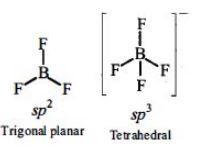
Which of the following conversions involves change in both shape and hybridisation?
  • A
    ${H_2}O\, \to \,{H_3}{O^ + }$
  • $B{F_3}\, \to \,BF_4^ - $
  • C
    $C{H_4}\, \to \,{C_2}{H_6}$
  • D
    $N{H_3}\, \to \,NH_4^ + $

Answer

Correct option: B.
$B{F_3}\, \to \,BF_4^ - $
b
$B{F_3}\, \to \,BF_4^ - $

Need a full question paper?

Generate a complete, print-ready paper with questions like this in minutes — across 16+ boards, with answer keys.

Start Generating Free

Similar questions

What will be the volume of $O_2$ gas at $STP$ which is obtained by thermal decomposition of $30.62\,g$ $KClO_3$, with $80\%$ purity ........... $\mathrm{L}$
Highest stable $Mn$ fluoride is $MnF_4$ where as highest $Mn$ oxide is $Mn_2O_7$ due to
Using the data provided, calculate the multiple bond energy $\left( kJ mol ^{-1}\right)$ of a $C \equiv C$ bond $C _2 H _2$. That energy is (take the bond energy of a $C - H$ bond as $350 \ kJ \ mol ^{-1}$ )

$2 C ( s )+ H _2( g ) \longrightarrow C _2 H _2( g ) \ \ \ \ \  \Delta H =225 \ kJ mol ^{-1} $

$2 C ( s ) \longrightarrow 2 C ( g )\ \ \ \ \ \ \Delta H =1410 \ kJ mol ^{-1} $

$H _2( g ) \longrightarrow 2 H ( g ) \ \ \ \ \ \  \Delta H =330 \ kJ mol ^{-1}$

The molarity of $1 \mathrm{~L}$ orthophosphoric acid $\left(\mathrm{H}_3 \mathrm{PO}_4\right)$ having $70 \%$ purity by weight (specific gravity $\left.1.54 \mathrm{~g} \mathrm{~cm}^{-3}\right)$ is_____$\quad \mathrm{M}$.

(Molar mass of $\mathrm{H}_3 \mathrm{PO}_4=98 \mathrm{~g} \mathrm{~mol}^{-1}$ )

Which of the following gases exist more abundantly in nature than the others
When $FeCl_3$ reacts with $K_4[Fe(CN)_6]$ then which of the following compound is formed
A $0.0020\, m$ aqueous solution of an ionic compound $[Co(NH_3)_5(NO_2)]Cl$ freezes at $- 0.00732\,^oC.$ Number of moles of ions which $1\, mol$ of ionic compound produces on being dissolved in water will be 

$(K_f =-1.86\,^o\,C/m)$

Given a $0.1\,M$ solution of each of the following. Which solution has the lowest $pH$
The complexes given below show :
Which of the following can show optical isomerism