MCQ
Which of the following do not reduce Fehling solution
  • A
    $CH_3CHO$
  • $Ph-CHO$
  • C
    $CH_3CH_2CHO$
  • D
    $HCHO$

Answer

Correct option: B.
$Ph-CHO$
b
Aromatic Aldehyde can not reduce fehling sol$^n$

Need a full question paper?

Generate a complete, print-ready paper with questions like this in minutes — across 16+ boards, with answer keys.

Start Generating Free

Similar questions

If g is the acceleration due to gravity at the earth's surface and $r$ is the radius of the earth, the escape velocity for the body to escape out of earth's gravitational field is
The current density is a solid cylindrical wire of radius $R ,$ as a function of radial distance $r$ is given by $J ( r )= J _{0}\left(1-\frac{ r }{ R }\right) .$ The total current in the radial region $r =0$ to $r =\frac{ R }{4}$ will be
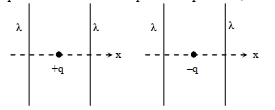
The figures below depict two situations in which two infinitely long static line charges of constant positive line charge density $\lambda$ are kept parallel to each other. In their resulting electric field, point charges $q$ and $- q$ are kept in equilibrium between them. The point charges are confined to move in the $x$ direction only. If they are given a small displacement about their equilibrium positions, then the correct statement$(s)$ is(are)
In the hydrogen spectrum, the ratio of the wavelengths for Lyman-alpha radiation to Balmer-alpha radiation is
The limiting friction is
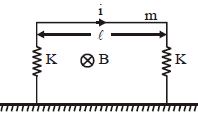
A horizontal metallic rod of mass $'m'$ and length $'l'$ is supported by two vertical identical springs of spring of spring constant $'K'$ each and natural length $l_0.$  A current $'i'$ is flowing in the rod in the direction shown. If the rod is in equilibrium then the length of each spring in this state is :-
A particle is moving in a circular path. The acceleration and momentum of the particle at a certain moment are $\vec a = (4\hat i + 3\hat j)\ m/s^2$ and $\vec p = (8\hat i - 6\hat j)\ kg-m/s$ . The motion of the particle is
A lead shot of $1mm$  diameter falls through a long column of glycerine. The variation of its velocity $v$. with distance covered is represented by
Logic gates are constructed by
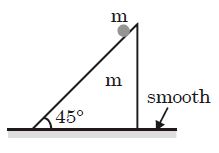
A ball of mass $'m'$ is released from the top of a smooth movable wedge of mass $'m'.$ When the ball collides with the floor,velocity of the wedge is $'v'.$ Then the maximum height attained by the ball after an elastic collision with the floor is :(Neglect any edge at the lower end of the wedge).