MCQ
Which of the following do not require medium for transmission
  • A
    Cathode ray
  • Electromagnetic wave
  • C
    Sound wave
  • D
    None of the above

Answer

Correct option: B.
Electromagnetic wave
b
(b) $EM$ waves do not requires medium for their propagation.

Need a full question paper?

Generate a complete, print-ready paper with questions like this in minutes — across 16+ boards, with answer keys.

Start Generating Free

Similar questions

A block is projected upwards on an inclined plane of inclination $37^o$ along the line of greatest slope of $\mu = 0.5$ with velocity of $5 m/s$. The block $1^{st}$ stops at $a$ distance of .......... $m$ from starting point
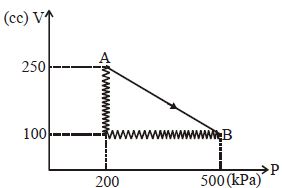
A monoatomic gas is taken along path $AB$ as shown. Calculate change in internal energy of system
According to Newton, the viscous force acting between liquid layers of area A and velocity gradient $\frac{\Delta v}{\Delta x}$ is given by $F=-\eta A \frac{\Delta v}{\Delta x}$, where $\eta$ is constant called coefficient of viscosity. The dimensional formula of $\eta$ is
A heavy mass is attached to a thin wire and is whirled in a vertical circle. The wire is most likely to break.
  1. When the mass is at the highest point.
  2. When the mass is at the lowest point.
  3. When the wire is horizontal.
  4. At an angle of $\cos^{-1}\Big(\frac{1}{3}\Big)$ from the upward vertical.
A thin circular ring of mass $M$ and radius $r$ is rotating about its axis with a constant angular velocity $\omega $. Two objects each of mass $m$ are attached gently to the opposite ends of a diameter of the ring. The ring will now rotate with an angular velocity
A light string passing over a smooth light pulley connects two blocks of masses m1 and m2 (vertically). If the acceleration of the system is (g/ 8), then the ratio of masses is:
A body crosses the topmost point of a vertical circle with critical speed. Its centripetal acceleration, when the string is horizontal will be
The relay satellite transmits the $T.V.$ programme continuously from one part of the world to another because its
The two interfering waves have intensities in the ratio $9 : 4$. The ratio of intensities of maxima and minima in the interference pattern will be
Two uniform solid balls of same density and of radii $r$ and $2r$ are dropped in air and fall vertically downwards. The terminal velocity of the ball with radius $r$ is $1\,cm\,s^{-1}$ , then find the terminal velocity of the ball of radius $2r$ (neglect bouyant force on the balls.) ........... $cm\,s^{-1}$