MCQ
Which of the following does not contain any co-ordinate bond?
- A$\text{H}_3\text{O}^+$
- B$\text{BF}_4^−$
- C$\text{HF}_2^−$
- D$\text{NH}_4^+$
Explanation:
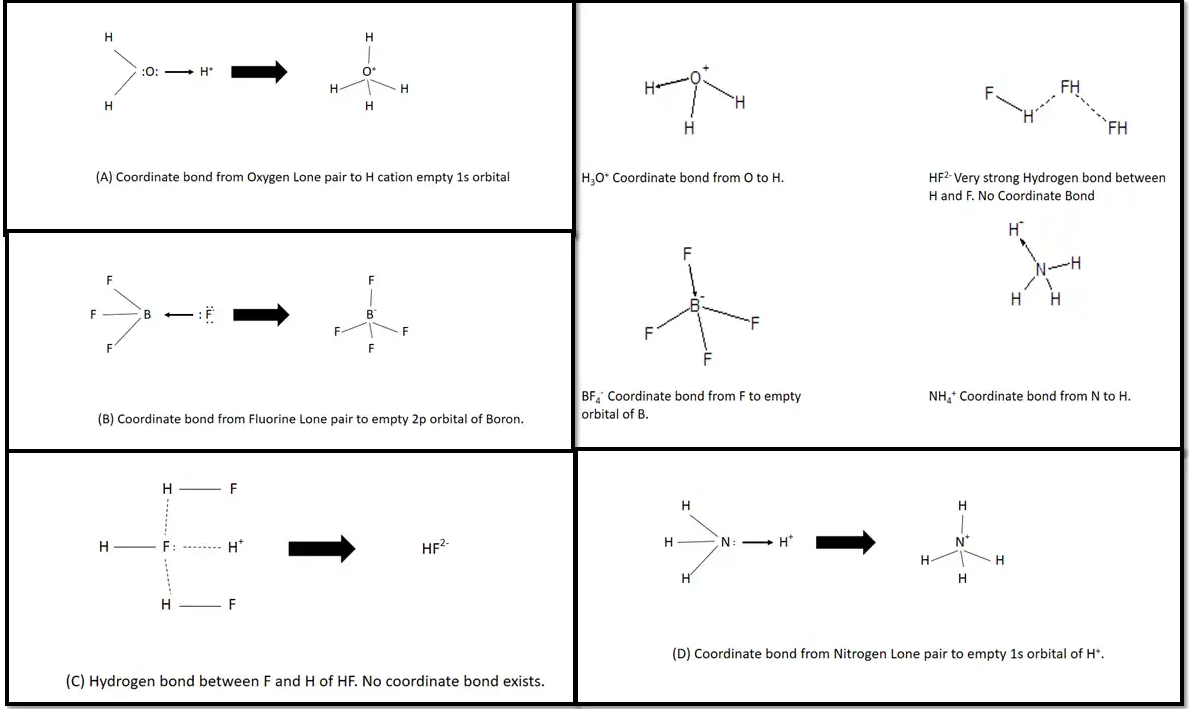
In option A, coordinate/dative bond is formed between lone pair of Oxygen atom and empty s orbital of H ion.
In option B, Boron atom has empty 2p orbital after formation of BF3, so it can accept lone pair of fluorine atom (F atom has 3 lone pairs) and form $\text{BF}_4^−$
In option C, there is no coordinate bonding but very strong Hydrogen bonding due to high electronegativity of Fluorine. (C) is the correct answer.
In option D, Nitrogen has one lone pair left after forming 3 covalent bonds with hydrogen, it forms coordinate bond by sharing that lone pair with H ion.
Generate a complete, print-ready paper with questions like this in minutes — across 16+ boards, with answer keys.

$(I)\, CO^{2-}_3$ $(II)\, XeF_4$ $(III)\, I^-_3$ $(IV)\, NCl_3$ $(V)$ $BeCl_2$