MCQ
Which of the following does not contain any co- ordinate bond?
- A$H_3O^+$
- B$BF^-_4$
- ✓$HF^-_2$
- D$NH^+_4$
In option $B$, Boron atom has empty $2 p$ orbital after formation of $BF _3$, so it can accept lone pair of fluorine atom ($F$ atom has $3$ lone pairs) and form $BF^{-} _4$.
In option $C$, there is no coordinate bonding but very strong Hydrogen bonding due to high electronegativity of Fluorine. $(C)$ is the correct answer.
In option $D$, Nitrogen has one lone pair left after forming $3$ covalent bonds with hydrogen, it forms coordinate bond by sharing that lone pair with $H$ ion.
Generate a complete, print-ready paper with questions like this in minutes — across 16+ boards, with answer keys.

(Image)
Samples $(A, B, C)$
Fig : Paper chromatography of Samples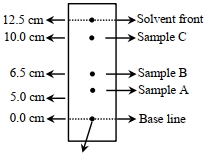
$Fe _{3} O _{4}( s )+4 CO ( g ) \rightarrow 3 Fe ( l )+4 CO _{2}( g )$
when $4.640 \,kg$ of $Fe _{3} O _{4}$ and $2.520 \,kg$ of $CO$ are allowed to react then the amount of iron (in $g$ ) produced is $....$
[Given : Molar Atomic mass $\left( g\, mol ^{-1}\right): Fe =56$
Molar Atomic mass $\left( g \,mol ^{-1}\right): 0=16$
Molar Atomic mass $\left( g\, mol ^{-1}\right):= C =12$
$4Fe + 3{O_2}\, \to \,4F{e^{3 + }} + 6{O^{2 - }}$
Which one of the following statement is incorrect