MCQ
Which of the following does not react with $PC{l_5}$
  • A
    $C{H_3}OH$
  • B
    $C{H_3}COOH$
  • C
    $C{H_3}CHO$
  • ${C_2}{H_6}$

Answer

Correct option: D.
${C_2}{H_6}$
d
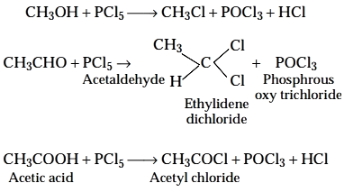
$PCl _5$ usually used to replace - $OH$ group or oxygen of carbonyl group.

Need a full question paper?

Generate a complete, print-ready paper with questions like this in minutes — across 16+ boards, with answer keys.

Start Generating Free

Similar questions

Alumina is insoluble in water because
Chlorobenzene on fusing with solid  $NaOH$  gives
Select the correct code about complex $[Cr(NO_2) (NH_3)_5 ] [ZnCl_4]$:

$(I)\, IUPAC$ name of compound is pentaamminenitrito $-N-$ chrornium $(III)$ tetrachlorozincate $(II)$

$(II)$ It shows geometrical isomerism

$(III)$ It shows linkage isomerism

$(IV)$ It shows coordination isomerism

Product $(A)$ of the reaction is
Which of the following reagents will convert propionic acid to $1-$ propanol ?
An amount of solid $N{H_4}HS$ is placed in a flask already containing ammonia gas at a certain temperature and $0.50$ $atm.$ pressure. Ammonium hydrogen sulphide decomposes to yield $N{H_3}$ and ${H_2}S$ gases in the flask. When the decomposition reaction reaches equilibrium, the total pressure in the flask rises to $0.84$ $atm$. The equilibrium constant for $N{H_4}HS$ decomposition at this temperature is
The standard reduction potentials at $298\,K$ for the following half reactions are given against each

$Z{n^{2 + }}\,(aq)\, + \,2e\, \rightleftharpoons \,Zn\,(s)\,;\, - \,0.762\,V$

$C{r^{3 + }}\,(aq)\, + \,3e\, \rightleftharpoons \,Cr(s)\,;\, - \,0.740\,\,V$

$2{H^ + }\,(aq)\, + \,2e\, \rightleftharpoons \,{H_2}(g)\,;\,\,\,0.00\,\,\,V$

$F{e^{3 + }}\,(aq)\, + \,e\, \rightleftharpoons \,F{e^{2 + }}(aq)\,;\,\,\,0.770\,\,\,V$

Which is the strongest reducing agent ?

Gabriel's phthalimide synthesis is used for the preparation of
Which of the following is most basic
A hydrocarbon contains $86\%$ carbon, $488\,ml$ of the hydrocarbon weight $1.68\, g$ at $STP$. Then the hydrocarbon is an