MCQ
Which of the following does not represent positive overlap?
- A
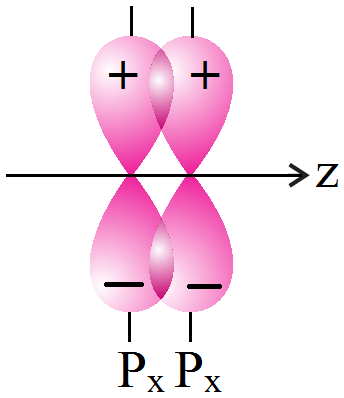
- B
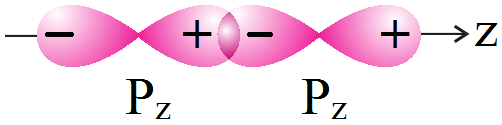
- C
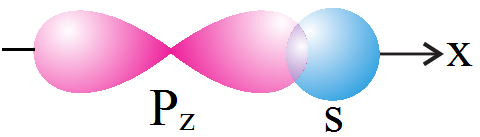
- D
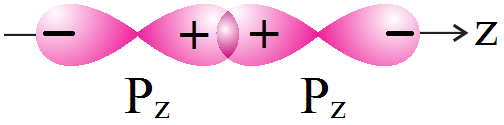
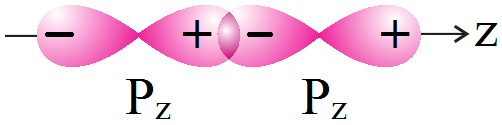
Explanation:
Out of phase overlap occurs in,
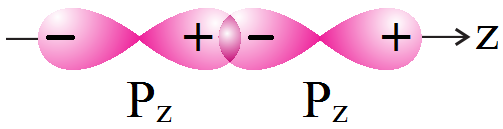
Thus, it shows negative overlap.
Generate a complete, print-ready paper with questions like this in minutes — across 16+ boards, with answer keys.
$(I)$ $CH_3COO^{\Theta}$ $(II)$ $CH_3O^{\Theta}$
$(III)$ $CH_3CH_2^{\Theta}$ $(IV)$ $CH_3SO_3^{\Theta}$
$kJ\,mol ^{-1}$ (Nearest integer)
Given : $\Delta_{ dis } H _{ Cl _{2(g)}}^{\circ}=240\,kJ\,mol ^{-1}$.
$\Delta_{ eg } H _{ Cl _{(g)}}^{\circ}=-350\,kJ\,mol ^{-1}$,
$\Delta_{ hyd } H _{ Cl i _{( j )}^{\circ}}^{\circ}=-380\,kJ\,mol ^{-1}$
| Column $I$ (Molecule/ion) | Column $II$ (Hybridisation) |
| $(A)$ $H_3O^+$ ion | $(P)$ $sp$ |
| $(B)$ $NH_2^-$ ion | $(Q)$ $sp^2$ |
| $(C)$ $NO_3^-$ ion | $(R)$ $sp^3$ |
| $(D)$ $ClF_3$ | $(S)$ $sp^3d$ |
| Element | $IE_1$ | $IE_2$ | $IE_3$ | $IE_4$ |
| $W$ | $10.5$ | $15.5$ | $24.9$ | $79.8$ |
| $X$ | $8$ | $14.8$ | $78.9$ | $105.8$ |
Other two elements $Y$ and $Z$ have outer electronic configuration $ns^2$ $np^4$ and $ns^2$ $np^5$ respectively. According to given information which of the following compound $(s)$ is/are not possible
$(a)\, W_2Y_3\, (b)\, X_2Y_3\, (c)\, WZ_2\, (d)\, XZ_2$