MCQ
Which of the following element has maximum binding energy per nucleon?
- AUranium
- BLithium
- CTungsten
- ✓Iron
Generate a complete, print-ready paper with questions like this in minutes — across 16+ boards, with answer keys.
A charge q is placed at the centre of a cube. Then the flux passing through one face of cube will be
|
(a) |
(b) |
(c) |
(d) |
The slope of frequency of incident light and stopping potential graph for a given surface will be
|
(a) h |
(b) h/e |
(c) eh |
(d) e |
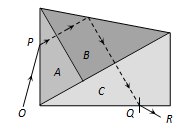
Three glass prisms A, B and C of same refractive index are placed in contact with each other as shown in figure, with no air gap between the prisms. Monochromatic ray of light OP passes through the prism assembly and emerges as QR. The conditions of minimum deviation is satisfied in the prisms
|
(a) A and C |
(b) B and C |
|
(c) A and B |
(d) In all prisms A, B and C |
Energy of an electron in an excited hydrogen atom is – 3.4 eV. Its angular momentum will be: h = 6.626 
|
(a) 1.11 |
(b) 1.51 |
(c) 2.11 |
(d) 3.72 |
Assertion : Corpuscular theory fails in explaining the velocities of light in air and water.
Reason : According to corpuscular theory, light should travel faster in denser medium than, in rarer medium.
|
(a) If both assertion and reason are true and the reason is the correct explanation of the assertion. |
|
(b) If both assertion and reason are true but reason is not the correct explanation of the assertion. |
|
(c) If assertion is true but reason is false. |
|
(d) If the assertion and reason both are false. |


