MCQ
Which of the following element has maximum density
  • A
    $Hg$
  • B
    $Au$
  • $Os$
  • D
    $Pb$

Answer

Correct option: C.
$Os$
c
Of all the metals, Osmium has the highest density of $22.59\,gm / cm ^3$.

Need a full question paper?

Generate a complete, print-ready paper with questions like this in minutes — across 16+ boards, with answer keys.
Start Generating Free

Similar questions

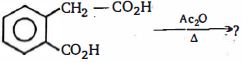
Indentify the product.
A chemist wants to determine the molecular geometry of the $[CoCl_4]^{2-}$ ion. Which of the following gives the best suggestion for a measurement and for the interpretation of that measurement ?
In collision theory of chemical reaction, $Z_{\text {AB }}$ represents
The valence shell electronic configuration of $C{r^{2 + }}$ ion is
Calculate the order of the reaction in $A$ and $B$

       $A$

       $(mol/l)$

      $B$

     $(mol/l)$

   Rate
       $0.05$       $0.05$  $1.2\times 10^{-3}$
       $0.10$       $0.05$  $2.4\times 10^{-3}$
       $0.05$       $0.10$  $1.2\times 10^{-3}$
Using the data given in find out in which option the order of reducing power is correct.
$\text{E}^\ominus_{\text{cr}_2\text{O}^{2-}_7/\text{cr}^{3+}}=1.33\text{V}\ \ \ \text{E}^\ominus_{\text{Cl}_2/\text{Cl}^-}=1.36\text{V}$
$\text{E}^\ominus_{\text{MnO}^-_4/\text{Mn}^{2+}}=1.51\text{V}\ \ \ \ \text{E}^\ominus_{\text{Cr}^{3+}/\text{Cr}}=-0.74\text{V}$
The $IUPAC$ name of $[Ni(NH_3)_4]\, [NiCl_4]$ is
$STATEMENT-1$: Aniline on reaction with $\mathrm{NaNO}_2 / \mathrm{HCl}$ at $0^{\circ} \mathrm{C}$ followed by coupling with $\beta$-naphthol gives a dark blue coloured precipitate. and

$STATEMENT-2$: The colour of the compound formed in the reaction of aniline with $\mathrm{NaNO}_2 / \mathrm{HCl}$ at $0^{\circ} \mathrm{C}$ followed by coupling with $\beta$-naphthol is due to the extended conjugation.

The correct order of ligands arranged in increasing field strength.
If $E_{{A^{ + 2}}/A}^o =  - 0.30\,V$ and $E_{{A^{ + 3}}/{A^{ + 2}}}^o = 0.40\,V$ the standard $EMF$ of the reaction : $A + 2A^{+3} \to 3A+2$ will be ............ $\mathrm{V}$