- A$5BiO_3^- + 22H^+ +Mn^{2+} \to 5Bi^{3+} + 7H_2O + MnO_4^-$
- ✓$5BiO_3^- + 14H^+ + 2Mn^{2+} \to 5Bi^{3+} + 7H_2O + 2MnO_4^-$
- C$2BiO_3^- + 4H^+ +Mn^{2+} \to 2Bi^{3+} + 2H_2O + MnO_4^-$
- D$6BiO_3^- + 12H^+ + 3Mn^{2+} \to 6Bi^{3+} + 6H_2O + 3MnO_4^-$
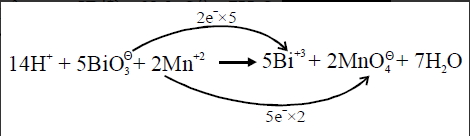
$5 \mathrm{BiO}_{3}^{-}+14 \mathrm{H}^{+}+2 \mathrm{Mn}^{2+} \rightarrow 5 \mathrm{Bi}^{3+}+7 \mathrm{H}_{2} \mathrm{O}+2 \mathrm{MnO}_{4}^{-}$
In this equation, the number of atoms of each element on the left side are equal to the number of atoms on the right side.
The charges are also balanced on the two sides of equation.
Hence, option B is the correct answer.
Generate a complete, print-ready paper with questions like this in minutes — across 16+ boards, with answer keys.
$(A)$ $\mathrm{Bi}_2 \mathrm{O}_5$ is more basic than $\mathrm{N}_2 \mathrm{O}_5$
$(B)$ $\mathrm{NF}_3$ is more covalent than $\mathrm{BiF}_3$
$(C)$ $\mathrm{PH}_3$ boils at lower temperature than $\mathrm{NH}_3$
$(D)$ The $\mathrm{N}-\mathrm{N}$ single bond is stronger than the $P-P$ single bond
$\begin{array} {|l|p{0.6\linewidth}|} \hline List\,\,I\,\,Equations & List\,\,II\,\,Type\,\,of\,\,processes \\ \hline A. K_p > Q & (i)\,\,Non-\,\,spontaneous \\ \hline B.\, \Delta G^o < RT ln Q & (ii)\,\,Equilibrium \\ \hline C. K_p=Q & (iii)\,\,Spontaneous\,\,and\,\,endothermic \\ \hline D. T > \frac{\Delta H}{\Delta S} & (iv)\,\,Spontaneous \\ \hline \end{array}$
$ \mathrm{CH}_3-\mathrm{CH}_2-\mathrm{CH}\left(\mathrm{NO}_2\right)-\mathrm{COOH} $
$ \mathrm{CH}_3-\mathrm{CH}_2-\mathrm{CHBr}-\mathrm{CH}_2-\mathrm{CH}_3 $
$ \mathrm{CH}_3-\mathrm{CH}(\mathrm{I})-\mathrm{CH}_2-\mathrm{NO}_2 $
$ \mathrm{CH}_3-\mathrm{CH}_2-\mathrm{CH}(\mathrm{OH})-\mathrm{CH}_2 \mathrm{OH} $
$ \mathrm{CH}_3-\mathrm{CH}-\mathrm{CH}(\mathrm{I})-\mathrm{C}_2 \mathrm{H}_5 $