MCQ
Which of the following expression is correct
  • $\Delta {G^o} = - nFE_{cell}^o$
  • B
    $\Delta {G^o} = + nFE_{cell}^o$
  • C
    $\Delta {G^o} = - 2.303\,RT\,nFE_{cell}^o$
  • D
    $\Delta {G^o} = - nF\,\log {K_C}$

Answer

Correct option: A.
$\Delta {G^o} = - nFE_{cell}^o$
a
(a)$\Delta {G^o} = - 2.303\,RT\,\log {K_{eq}}$

or $\Delta {G^o} = - nFE_{cell}^o$

Need a full question paper?

Generate a complete, print-ready paper with questions like this in minutes — across 16+ boards, with answer keys.
Start Generating Free

Similar questions

In Dumas' method for estimation of nitrogen 0.4 g of an organic compound gave 60 mL of nitrogen collected at 300 K temperature and 715 mm Hg pressure. The percentage composition of nitrogen in the compound is
(Given : Aqueous tension at $300 \mathrm{~K}=15 \mathrm{~mm} \mathrm{Hg}$ )
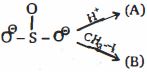
Product $(A)$ and $(B)$ in above reaction is
Complex which show linkage isomerism is
Correct set of four quantum numbers for valence electron of rubidium $ (Z = 37)$  is
Sugar of lead is
A photon-sensitive metal is not emitting photoelectron when irradiated. It will do so when threshold is crossed. To cross the threshold we need to increase:
Which of the following options represents the correct bond order?
The rate of a reaction quadruples when temperature changes from $27^{\circ} \mathrm{C}$ to $57^{\circ} \mathrm{C}$. Calculate the energy of activation.

Given $\mathrm{R}=8.314 \mathrm{~J} \mathrm{~K}^{-1} \mathrm{~mol}^{-1}, \log 4=0.6021$

Value of ${K_p}$ in the reaction $MgC{O_{3(s)}}$ $\rightleftharpoons$ $Mg{O_{(s)}}$ $ + \,C{O_{2(g)}}$ is
Given below are two statements:

Statement $I$: The boiling point of hydrides of Group $16$ elements follow the order

$\mathrm{H}_2 \mathrm{O}>\mathrm{H}_2 \mathrm{Te}>\mathrm{H}_2 \mathrm{Se}>\mathrm{H}_2 \mathrm{~S}$.

Statement $II$: On the basis of molecular mass, $\mathrm{H}_2 \mathrm{O}$ is expected to have lower boiling point than the othe members of the group but due to the presence of extensive $\mathrm{H}$-bonding in $\mathrm{H}_2 \mathrm{O}$, it has higher boiling point.

In the light of the above statements, choose the correct answer from the options given below: