MCQ
Which of the following fluorides can react with fluorine
- A$SF_6$
- B$IF_5$
- C$KF$
- ✓$MgF_2$
$Cl _{2}> Br _{2}> F _{2}> I _{2}$
Fluorine has very small size due to which inter-electronic repulsion is there between two fluorine atoms this results in the weaken bond.
Generate a complete, print-ready paper with questions like this in minutes — across 16+ boards, with answer keys.
$\begin{array}{*{20}{c}}
{C{H_3} - CH - COOH} \\
{|\,\,\,\,\,\,\,\,\,\,\,\,\,} \\
{OH\,\,\,\,\,\,\,\,\,}
\end{array}\xrightarrow{\Delta }[Y]$
$[Y]$ will be :
$I.$ There is no $P_{\pi } -P_{\pi }$ bonds present in the molecule
$II.$ There are eight lone pair of electrons
$III.$ Each $S$ atom is $sp^3$ hybridised
$\gamma_{1} A +\gamma_{2} B \rightarrow \gamma_{3} C +\gamma_{4} D$
Concentration of $C$ changes from $10\, mmol$ appearance of $D$ is $1.5$ times the rate of disappearance of $B$ which is twice the rate of disappearance $A$. The rate of appearance of $D$ has been experimentally determined to be $9 \,m\,mol$ $dm ^{-3} s ^{-1}$. Therefore the rate of reaction is $......\,m\,mol\, dm ^{-3} \,s ^{-1}$. (Nearest Integer)
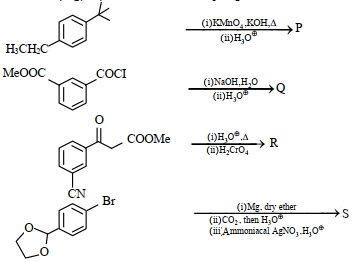
The correct statement ($s$) about $P, Q, R$, and $S$ is (are)
($A$) $P$ and $Q$ are monomers of polymers dacron and glyptal, respectively.
($B$) $P, Q$, and $R$ are dicarboxylic acids.
($C$) Compounds $Q$ and $R$ are the same.
($D$) $R$ does not undergo aldol condensation and $S$ does not undergo Cannizzaro reaction.