MCQ
Which of the following formulae is wrong
  • A
    ${C_V} = \frac{R}{{\gamma - 1}}$
  • B
    ${C_P} = \frac{{\gamma \,R}}{{\gamma - 1}}$
  • C
    ${C_p}/{C_v} = \gamma $
  • ${C_P} - {C_V} = 2R$

Answer

Correct option: D.
${C_P} - {C_V} = 2R$
d
The difference between $C_P$ and $C_V$ is $R$, not $2R$.

Need a full question paper?

Generate a complete, print-ready paper with questions like this in minutes — across 16+ boards, with answer keys.
Start Generating Free

Similar questions

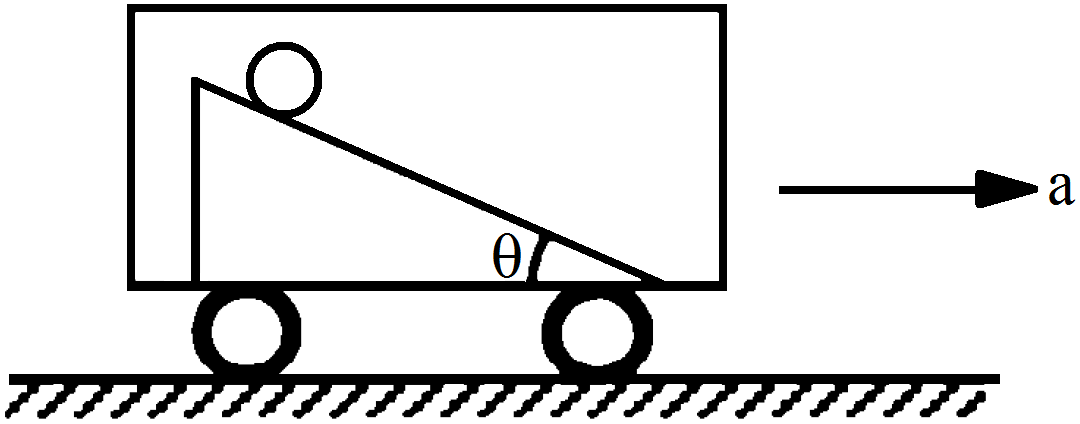
Figure shows a smooth inclined plane fixed in a car accelerating on a horizontal road. The angle of incline 0 is related to the acceleration a of the car as a = g tan°. If the sphere is set in pure rolling on the incline:

A wave is represented by the equation $y = 7\sin \{ \pi (2t - 2x)\} $ where $x$ is in metres and $t$ in seconds. The velocity of the wave is ..... $m/s$
If the pressure amplitude in a sound wave is tripled, then the intensity of sound is increased by a factor of
Which of the following is the incorrect graph for a sphere falling in a viscous liquid? (Given at $t = 0$, velocity $v = 0$ and displacement $x = 0$.) 
In stationary wave
The adiabatic elasticity of hydrogen gas $(\gamma = 1.4)$ at $NTP$ is
The molecules of a given mass of a gas have a $r.m.s.$ velocity of $200\, m/sec$ at $27°C$ and $1.0 \times {10^5}\,N/{m^2}$ pressure. When the temperature is $127°C$ and pressure is $0.5 \times {10^5}\,N/{m^2}$, the $r.m.s.$ velocity in $m/sec$ will be
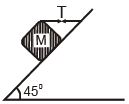
A block of mass $15 \,kg $ is resting on a rough inclined plane as shown in figure. The  block is tied up by a horizontal string which has tension of $50\,N$. The minimum  coefficient of friction between the surfaces of contact is $(g = 10\,m/s^2)$
Pick the correct options:
  1. Magnetic field is produced by electric charges only.
  2. Magnetic poles are only mathematical assumptions having no real existence.
  3. A north pole is equivalent to a clockwise current and a south pole is equivalent to an anticlockwise current.
  4. A bar magnet is equivalent to a long, straight current.
The filament of a light bulb has surface area $64 mm ^2$. The filament can be considered as a black body at temperature $2500 K$ emitting radiation like a point source when viewed from far. At night the light bulb is observed from a distance of $100 m$. Assume the pupil of the eyes of the observer to be circular with radius $3 mm$. Then

(Take Stefan-Boltzmann constant $=5.67 \times 10^{-8} Wm ^{-2} K ^{-4}$, Wien's displacement constant $=2.90 \times 10^{-3} m - K$, Planck's constant $=6.63 \times 10^{-34} Js$, speed of light in vacuum $=3.00 \times 10^8 ms ^{-1}$ )-

$(A)$ power radiated by the filament is in the range $642 W$ to $645 W$

$(B)$ radiated power entering into one eye of the observer is in the range $3.15 \times 10^{-8} W$ to $3.25 \times 10^{-8} W$

$(C)$ the wavelength corresponding to the maximum intensity of light is $1160 nm$

$(D)$ taking the average wavelength of emitted radiation to be $1740 nm$, the total number of photons entering per second into one eye of the observer is in the range $2.75 \times 10^{11}$ to $2.85 \times 10^{11}$