MCQ
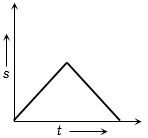
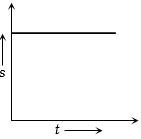
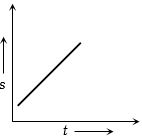
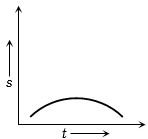
Which of the following graph represents uniform motion

  • B

  • C

  • D

Answer

Correct option: A.

a
(a)This graph shows uniform motion because line having a constant slope.

Need a full question paper?

Generate a complete, print-ready paper with questions like this in minutes — across 16+ boards, with answer keys.
Start Generating Free

Similar questions

A spherical ball contracts in volume by $0.02 \%$, when subjected to a normal uniform pressure of $50$ atmosphere. The Bulk modulus of its material is ...............  $N / m ^2$
The ratio of the radius of a planet $‘A’$ to that of planet $‘B’$ is $‘r’$. The ratio of acceleration due to gravity on the planets is $‘x’$. The ratio of the escape velocities from the two planets is
The displacement of a particle is represented by the equation : $\text{y}=3\cos\Big(\frac{\pi}{4}-2\omega\text{t}\Big)$
The motion of the particle is:
A billiard ball is hit by a cue at a point distance $h$ above the centre. It acquires a linear velocity $v_0$. Let $m$ be the mass and $r$ be the radius of the ball. The angular velocity acquired by the ball is
Minimum and maximum values of Poisson’s ratio for a metal lies between
Imagine a new planet having the same density as that of earth but it is $3$ times bigger than the earth in size. If the acceleration due to gravity on the surface of earth is $g$ and that on the surface of the new planet is $g^{\prime}$, then
A satellite of mass $m$ is in circular orbit of radius $3 R_E$ about earth (mass of earth $M_{E}$, radius of earth $R_{E}$). How much additional energy is required to transfer the satellite to an orbit of radius $9 R_{E}$?
Which of the following graphs best represents the motion of a raindrop?
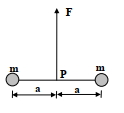
Two particle of mass $m$ each are tied at the ends of a light string of length $2 \mathrm{a}$. The whole system is kept on a frictionless horizontal surface with the string held tight so that each mass is at a distance $'a'$ from the center $\mathrm{P}$ (as shown in the figure). Now, the mid-point of the string is pulled vertically upwards with a small but constant force $F$. As a result, the particles move towards each other on the surface. The magnitude of acceleration, when the separation between them becomes $2 \mathrm{x}$ is
If $\overrightarrow A = 3\hat i + \hat j + 2\hat k$ and $\overrightarrow B = 2\hat i - 2\hat j + 4\hat k$ then value of $|\overrightarrow A \times \overrightarrow B |\,$ will be