MCQ
Which of the following group of elements eliminates electron easily
  • A
    $N, P, As$
  • B
    $O, S, Se$
  • $Li, Na, K$
  • D
    $Cl, Ba, I$

Answer

Correct option: C.
$Li, Na, K$
c
(c) $Li, Na, K$, contains only one ${e^ - }$ in outer most orbit.

Need a full question paper?

Generate a complete, print-ready paper with questions like this in minutes — across 16+ boards, with answer keys.

Start Generating Free

Similar questions

$X-O-X$ linkage present in $[X = P/S/Cl/Mn]$

$(a) P_2O_7^{4-}$                                           $(b) S_2O_5^{2-}$

$(c) S_2O_7^{2-}$                                            $(d) Cl_2O_7$

$(e) Mn_2O_7$                                         $(f) S_2O_8^{2-}$

If  $25\,ml$ of $0.25\,M \,\,NaCl $ solution is diluted with water to a volume of $500\,ml$  the new concentration of the solution is
Assertion : Acetamide reacts with $Br_2$ in presence of methanolic $CH_3ONa$ to form methyl $N-$ methylcarbamate.
Reason : Methyl isocyanate is formed as an intermediate which reacts with methanol to form methyl $N-$ methylcarbamate.
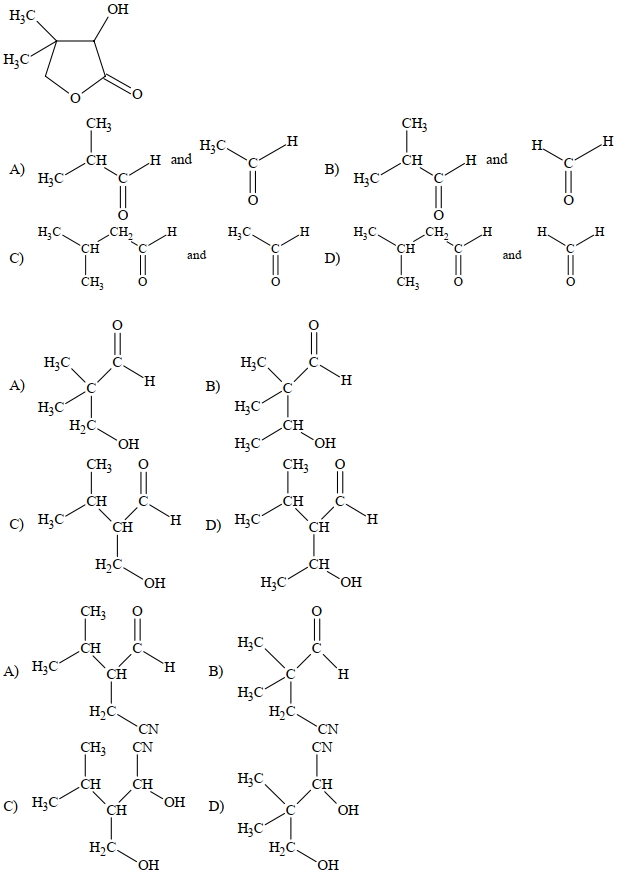
Two aliphatic aldehydes $\mathrm{P}$ and $\mathrm{Q}$ react in the presence of aqueous $\mathrm{K}_2 \mathrm{CO}_3$ to give compound $\mathrm{R}$, which upon treatment with $\mathrm{HCN}$ provides compound $\mathrm{S}$. On acidification and heating, $\mathrm{S}$ gives the product shown below: $Image$

$1.$ The compounds $\mathrm{P}$ and $\mathrm{Q}$ respectively are

MCQ $Image$

$2.$ The compound $R$ is

MCQ $Image$

$3.$ The compound $\mathrm{S}$ is

MCQ $Image$

Give the answer question $1,2$ and $3.$
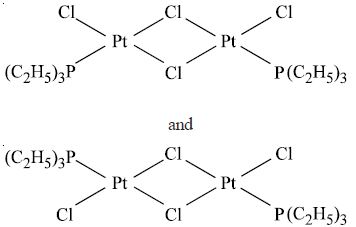
The complexes given below show :
A piston filled with $0.04\, mol$ of an ideal gas expands reversibly from $50.0\, mL$ to $375\, mL$ at a constant temperature of $37.0\,^oC.$ As it does so, it absorbs $208\, J$ of heat. The values of $q$ and $w$ for the process will be

$(R = 8.314 \,J/mol\,K)\,(\ln 7.5 =2.01)$

Select the compound in which $HCl$ is not the product of Hydrolysis
From Williamson’s synthesis preparation of which of following is possible
Two solutions of $KNO_3$ and $CH_3COOH$ are prepared separately. Molarity of both is $0.1\, M$ and osmotic pressures are $P_1$ and $P_2$ respectively. The correct relationship between the osmotic pressures is :-
The correct order for the wavelength of absorption in the visible region is