MCQ
Which of the following halogens does not form oxyacid
  • Fluorine
  • B
    Chlorine
  • C
    Bromine
  • D
    Iodine

Answer

Correct option: A.
Fluorine
a
(a)Fluorine does not form oxyacids because it is more electronegative than oxygen.

Need a full question paper?

Generate a complete, print-ready paper with questions like this in minutes — across 16+ boards, with answer keys.

Start Generating Free

Similar questions

Which of the following compound undergo cannizaro reaction

$(a)$ $HCHO$          $(b)$ $C_6H_5-CHO$

$(c)$ $\begin{array}{*{20}{c}}
  {\,\,C{H_3}} \\ 
  {\,|\,\,\,\,\,} \\ 
  {C{H_3} - C - CHO} \\ 
  {|\,\,\,} \\ 
  {\,\,C{H_3}\,} 
\end{array}$           $(d)$ $Ph-CH_2-CHO$

The percentage of $p$-character in the orbitals forming $\mathrm{P}-\mathrm{P}$ bonds in $\mathrm{P}_4$ is
A solution containing $12.5\, g $ of non-electrolyte substance in $250\, g$ of water shows  boiling point elevation of $0.52\, K.$ Calculate the molar mass of the substance. $(K_b = 0.52\, K \, kg \,mol^{-1})$ ......... $g \,mol^{-1}$.
An unknown compound $A$ has a molecular formula ${C_4}{H_6}.$ When $A$ is treated with an excess of $B{r_2}$ a new substance $B$ with formula ${C_4}{H_6}B{r_4}$ is formed. $A$ forms a white precipitate with ammoniacal silver nitrate solution. $A$ may be
Calculate the enthalpy change for the reaction

$H_2 + F_2 \longrightarrow 2HF$

given that
Bond energy of $H-H$ bond $= 434\, kJ/mol$
Bond energy of $F-F$ bond $= 158\, kJ/mol$
Bond energy of $H-F$ bond $= 565\, kJ/mol$

.....$ kJ$
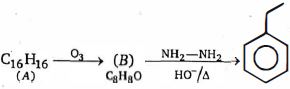
Reactant $(A)$ in this reaction is
Which of the following reactions end in finite time
Which of the following is $\pi$ complex :
Identify product $( A )$ is the following reaction :
In Carius method of estimation of halogens, $250 \,mg$ of an organic compound gave $141 \,mg$ of $AgBr.$ The percentage of bromine in the compound is : 

(at. mass $Ag =108; Br = 80$)