MCQ
Which of the following has most acidic hydrogen?
  • A
    $2, 3 -$Hexanedione
  • B
    $2, 5-$Hexanedione
  • $2, 4 -$Hexanedione
  • D
    $3 -$Hexanone

Answer

Correct option: C.
$2, 4 -$Hexanedione
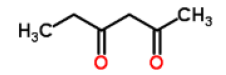
$ 2,4-$hexanedione will have active methylene group.
The structure of $2,4-$hexanedione is

Image
$-CH_2$ group present between the two carbonyl group is active methylene group, these hydrogens are highly acidic as their conjugate base is highly stable.

Need a full question paper?

Generate a complete, print-ready paper with questions like this in minutes — across 16+ boards, with answer keys.

Start Generating Free

Similar questions

The rate constant of a first order reaction is $3 \times {10^{ - 6}}$ per second. If the initial concentration is $0.10\,m$ , the initial rate of reaction is
In this reaction $C{H_3}CHO + HCN$$C{H_3}CH(OH)CN\xrightarrow{{{H^ + }/O{H^ - }}}C{H_3}CH(OH)COOH$ an asymmetric centre is generated. The acid obtained would be
Which of the following statement is not true for glucose?
Acetic acid will be obtained on oxidation of
Which of the following undergoes nucleophilic substitution by ${SN^1}$ mechanism
The solution containing $4.0\,gm$ of a polyvinyl chloride polymer in $1\,litre$ of dioxane was found to have an osmotic pressure $6.0 \times {10^{ - 4}}$ atmosphere at $300\,K$, the value of $R $ used is $0.082\,litre$ atmosphere $mol{e^{ - 1}}{k^{ - 1}}$. The molecular mass of the polymer was found to be
Which of the following is not a colligative property
Silver nitrate is supplied in coloured bottles because it is
The reagent with which both aldehyde and acetone react easily is
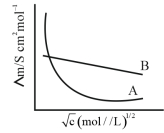
Following figure shows dependence of molar conductance of two electrolytes on concentration. $\Lambda \stackrel{0}{ m }$ is the limiting molar conductivity.The number of Incorrect statement(s) from the following is $...........$

$(A)$ $\Lambda \stackrel{0}{ m }$ for electrolyte $A$ is obtained by extrapolation

$(B)$ For electrolyte B, vx $\Lambda m$ vs $\sqrt{ c }$ graph is a straight line with intercept equal to $\Lambda \stackrel{0}{ m }$

$(C)$ At infinite dilution, the value of degree of dissociation approach zero for electrolyte $B$.

$(D)$ $\Lambda \stackrel{0}{ m }$ for any electrolyte $A$ or $B$ can be calculated using $\lambda^{\circ}$ for individual ions.