MCQ
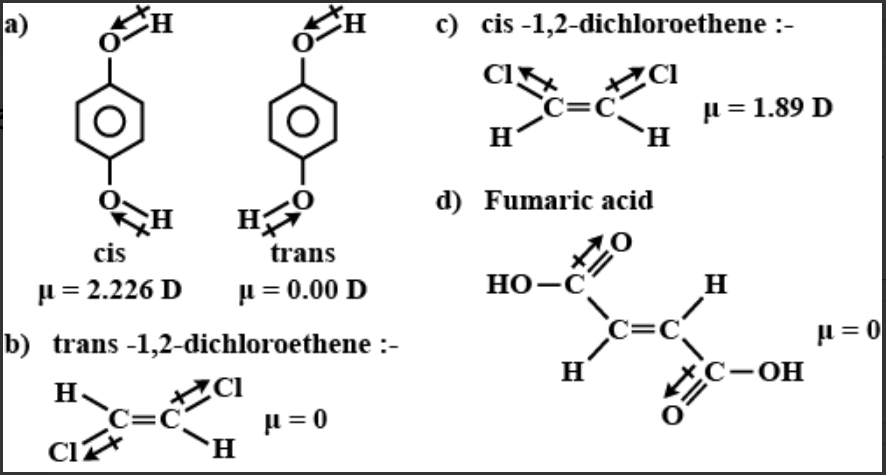
Which of the following has zero dipole moment?
  • A
    Benzene-1, 4 - diol
  • B
    trans-1, 2 - dichloroethene
  • C
    cis-1, 2 - dichloroethene
  • D
    Fumeric acid

Answer

  1. trans-1, 2 - dichloroethene

Explanation:

Need a full question paper?

Generate a complete, print-ready paper with questions like this in minutes — across 16+ boards, with answer keys.

Start Generating Free

Similar questions

In general, the properties that decrease and increase down a group in the periodic table respectively are
Successive members of homologous series differ from one another in their mass by:
The total number of molecules with zero dipole moment among $\mathrm{CH}_4, \mathrm{BF}_3, \mathrm{H}_2 \mathrm{O}, \mathrm{HF}, \mathrm{NH}_3, \mathrm{CO}_2$ and $\mathrm{SO}_2$ is_______
Which statement is false for the balanced equation given below ?

$CS_2 + 3O_2 \,\,\to \,\, 2SO_2 + CO_2$

During the formation of a molecular orbital from atomic orbitals, probability of electron density is
Rank the transition states that occur during the following reaction steps in order of
increasing stability (least $\to$ most stable)

$1. \,{H_3}C - \mathop O\limits^ +  {H_2} \to CH_3^ +  + {H_2}O$

$2.\,{(C{H_3})_3}C - \mathop O\limits^ +  {H_2} \to {(C{H_3})_3}{C^ + } + {H_2}O$

$3.\,{(C{H_3})_2}CH - \mathop O\limits^ +  {H_2} \to {(C{H_3})_2}C{H^ + } + {H_2}O$

Match the coordination number and type of hybridisation with distribution of hybrid orbitals in space based on Valence bond theory.

Coordination number and type of hybridisation Distribution of hybrid orbitals In space
$(a)$ $4, sp ^{3}$ $(i)$ trigonal bipyramidal
$(b)$ $4, dsp ^{2}$ $(ii)$ octahedral 
$(c)$ $5, sp ^{3} d$ $(iii)$ tetrahedral
$(d)$ $6, d ^{2} sp ^{3}$ $(iv)$ square planar

Select the correct option

The total number of contributing structures showing hyperconjugation (involving $C - H$ bonds) for the following carbocation is
$C{H_2} = C{H_2}   \xrightarrow[KOH / H_2o ]{KMnO_4} \mathop {}\limits_{} X$ . Product ‘$X$’ in above reaction is
The standard electrode potential $E^-$ and its temperature coefficient $\left( {\frac{{d{E^ - }}}{{dT}}} \right)$ for a cell are $2\,V$ and $-\,5\times10^{-4}\,V\,K^{-1}$ at $300\,K$ respectively. The cell reaction is

$Zn\left( s \right) + C{u^{2 + }}\left( {aq} \right) \rightleftharpoons Z{n^{2 + }}\left( {aq} \right) + Cu\left( s \right)$

Standard reaction enthalpy $\left( {{\Delta _r}{H^ - }} \right)$ .......  $\mathrm{kJ}$