MCQ
Which of the following has/have zero average value in a plane electromagnetic wave?
  • Both magnetic and electric field
  • B
    Electric field only
  • C
    Magnetic energy
  • D
    Electric energy

Answer

Correct option: A.
Both magnetic and electric field

Need a full question paper?

Generate a complete, print-ready paper with questions like this in minutes — across 16+ boards, with answer keys.
Start Generating Free

Similar questions

When a ray of light emerges from a block of glass, the critical angle is
Infrared radiation are detected by:
Photo-electric effect can be explained by
Two capacitors of capacitances $3\,\mu \,F$ and $6\,\mu F$ are charged to a potential of $12 \,V$ each. They are now connected to each other, with the positive plate of each joined to the negative plate of the other. The potential difference across each will be......$volt$
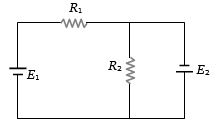
Two resistances ${R_1}$ and ${R_2}$ are joined as shown in the figure to two batteries of $e.m.f.$ ${E_1}$ and ${E_2}$. If ${E_2}$ is short-circuited, the current through ${R_1}$ is
A particle having some charge is projected in $x-y$ plane with a speed of $5\ m/s$ in a region having uniform magnetic field along $z-$ axis. Which of the following cannot be the possible value of velocity at any time ?
If a step up transformer have turn ratio $5$, frequency $50\,Hz$ root mean square value of potential difference on primary $100\,volts$ and the resistance of the secondary winding is $500\,\Omega $ then the peak value of voltage in secondary winding will be (the efficiency of the transformer is hundred percent)
Ten capacitor are joined in parallel and charged with a battery up to a potential V. They are then disconnected from battery and joined again in series then the potential of this combination will be
In the experiment of potentiometer, at balance point, there is no current in the:
A system of three polarizers $P_1, P_2, P_3$ is set up such that the pass axis of $P_3$ is crossed with respect to that of $P_1$. The pass axis of $P_2$ is inclined at $60^o$ to the pass axis of $P_3$. When a beam of unpolarized light of intensity $I_0$ is incident on $P_1$, the intensity of light transmitted by the three polarizers is $I$. The ratio $(I_0/I)$ equals (nearly)