MCQ
Which of the following have high electron affinity
  • A
    $F$
  • $Cl$
  • C
    $N$
  • D
    $O$

Answer

Correct option: B.
$Cl$
b
(b) The electron affinities of some of the elements of second period (i.e., $N,\,O,\,F$ etc.) are however, lower than the corresponding elements (i.e., $P, S, Cl,$ etc.) of the third period.

This is due to the reason that the elements of second period have the smallest atomic size amongst the elements in their respective groups.

As a result, there are considerable electron-electron repulsion within the atom itself and hence the additional electron is not accepted with the same ease as is the case with the remaining elements in the same group.

Need a full question paper?

Generate a complete, print-ready paper with questions like this in minutes — across 16+ boards, with answer keys.

Start Generating Free

Similar questions

If Avogadro number $N_A,$ is changed from $6.022 \times 10^{23}\ mol^{-1}$ to $6.022 \times 10^{20}\ mol^{-1},$ this would change
The reactivities of methyl chloride, propyl chloride and chlorobenzene are in the order
In a reaction $A_2B_3(g) \to A_2(g) + \frac{3}{2}B_2(g)$, the pressure increases from $60$ torr to $75$  torr in $2.5\, minutes$. The rate of disappearance of $A_2B_3$ is ........ $torr\, min^{-1}$
For the reaction; $PCl_{5(g)}  \rightleftharpoons  PCl_{3(g)} +Cl_{2(g)}$ the forward reaction at constant temperature is not favoured by
The Structural formula of an amino acid, isoleucine is
The type of magnetism exhibited by ${\left[ {Mn{{\left( {{H_2}O} \right)}_6}} \right]^{2 + }}$ ion is
Three allotropes $(A), (B)$ and $(C)$ of phoiphorous in the following change are respectively

$A\,\xrightarrow[{1200\,\,atm}]{{470\,\,K}}B$

$A\,\xrightarrow[{C{O_2}\, - \,atm}]{{570\,\,K}}C$

Consider the following ionisation reactions

$I.E.\, (kJ \,mol^{-1})$ $I.E.\, (kJ\, mol^{-1})$
$A_{(g)} \to A^+_{(g)}+e^-,$     $A_1$ $B_{(g)} \to B^{+}_{(g)}+e^-,$     $B_1$
$B^+_{(g)} \to B^{2+}_{(g)}+e^-,$     $B_2$ $C_{(g)} \to C^{+}_{(g)}+e^-,$     $C_1$
$C^+_{(g)} \to C^{2+}_{(g)}+e^-,$     $C_2$ $C^{2+}_{(g)} \to C^{3+}_{(g)}+e^-,$     $C_3$

If monovalent positive ion of $A,$ divalent positive ion of $B$ and trivalent  positive ion of $C$ have zero electron. Then incorrect order of corresponding  $I.E.$ is
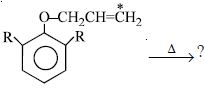
Product is :
How many isomers are possible for the following molecule ?