MCQ
Which of the following (if mass and radius are assumed to be same) have maximum percentage of total $K.E.$ in rotational form while pure rolling?
  • A
    Disc
  • B
    Sphere
  • Ring
  • D
    Hollow sphere

Answer

Correct option: C.
Ring
c
(c)

$K _{\text {Rother }}= K _{\text {Trenstation }}+ K _{\text {rotaton }}$

$=\frac{1}{2} m v^2+\frac{1}{2} l \omega^2$

$=\frac{1}{2} m R^2 \omega^2+\frac{1}{2}\left|\omega^2=\frac{1}{2}\right| \omega^2\left(1+\frac{m R^2}{1}\right)$

$\Rightarrow$ ratio $=\frac{K_{\text {waton }}}{K_{\text {total }}}=\frac{\frac{1}{2} I ^2}{\frac{1}{2} I_{\omega^2}\left(1+\frac{m R^2}{1}\right)}$

$=\frac{1}{1+\frac{m R^2}{1}}$

For disc,

$\text { Ratio }=\frac{1}{1+\frac{m R^2}{\left(\frac{m R^2}{2}\right)}}=\frac{1}{3}$

Solid sphere

$\text { Ratio }=\frac{1}{1+\frac{m R^2}{\frac{2}{5} m R^2}}=\frac{2}{7}$

Ring

$\text { Ratio }=\frac{1}{1+\frac{m R^2}{m R^2}}=\frac{1}{2}$

Hollow sphere ratio $=\frac{1}{1+\frac{m R^2}{\frac{2}{3} m R^2}}=\frac{2}{5}$

Hence $ring$ correct option.

Need a full question paper?

Generate a complete, print-ready paper with questions like this in minutes — across 16+ boards, with answer keys.
Start Generating Free

Similar questions

Gravitational potential difference between surface of a planet and a point situated at a height of $20\,m$ above its surface is $2\,joule/kg$. If gravitational field is uniform, then the work done in taking a $5\,kg$ body of height $4\,meter$ above surface will be ........ $J$
A particle is moving in one dimension (along $\mathrm{x}$ axis) under the action of a variable force. It's initial position was $16 \mathrm{~m}$ right of origin. The variation of its position ( $\mathrm{x}$ ) with time ( $\mathrm{t})$ is given as $\mathrm{x}=-3 \mathrm{t}^5+18 \mathrm{t}^2+16 \mathrm{t}$, where $\mathrm{x}$ is in $\mathrm{m}$ and $\mathrm{t}$ is in $\mathrm{s}$. The velocity of the particle when its acceleration becomes zero is________ $\mathrm{m} / \mathrm{s}.$
The power of a pump, which can pump $500 \,kg$ of water to height $100 \,m$ in $10 \,s$ is .......... $kW$
A body is projected at an angle $\theta $ with horizontal, another body is projected with the same speed at an angle $\theta $ with the vertical then the ratio of the maximum height is
How many times is escape velocity $({V_e})$, of orbital velocity $({V_0})$ for a satellite revolving near earth
A ball of mass $160\, g$ is thrown up at an angle of $60^{\circ}$ to the horizontal at a speed of $10 \,m / s$. The angular momentum of the ball at the highest point of the trajectory with respect to the point from which the ball is thrown is nearly $\left(g=10\, m / s ^{2}\right)$ (in $kgm ^{2} / s$)
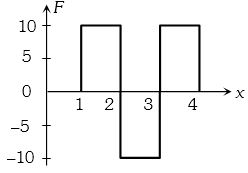
Figure shows the $F-x$ graph. Where $F$ is the force applied and $x$ is the distance coveredby the body along a straight line path. Given that $F$ is in newton and $x$ in metre, ........ $J$ is the work done.
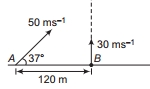
Balls $A$ and $B$ are thrown from two points lying on the same horizontal plane separated by a distance $120\,m$. Which of the following statement$(s)$ is/are correct.
One of the following wavelengths is absent and the rest are present in the X-rays coming from a Coolidge tube. Which one is the absent wavelength?
Following statements are given :

$(1)$ The average kinetic energy of a gas molecule decreases when the temperature is reduced.

$(2)$ The average kinetic energy of a gas molecule increases with increase in pressure at constant temperature.

$(3)$ The average kinetic energy of a gas molecule decreases with increases in volume.

$(4)$ Pressure of a gas increases with increase in temperature at constant pressure.

$(5)$ The volume of gas decreases with increase in temperature.

Choose the correct answer from the options given below: