MCQ
Which of the following ionic radius would be maximum
  • ${C^{4 - }}$
  • B
    ${N^{3 - }}$
  • C
    ${O^{2 - }}$
  • D
    $M{g^{2 + }}$

Answer

Correct option: A.
${C^{4 - }}$
a
(a)${C^{4 - }}$ has largest radius due to least nuclear charge per electron.

Need a full question paper?

Generate a complete, print-ready paper with questions like this in minutes — across 16+ boards, with answer keys.
Start Generating Free

Similar questions

Nitration of benzoic acid gives
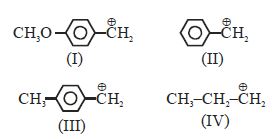
Arrange the following carbocation in increasing order of stability
Maximum number of electrons in a subshell with $l = 3$ and $n = 4$ is
What will be the coefficients in the balanced form of following equation  $xIO_3^ - \, + \,yHSO_3^ - \, \to \,z{I^ - }\, + \,p{H^ + }\, + \,qSO_4^{-2}$ 

$x\,\,\,\,\,\,\,\,\,\,y\,\,\,\,\,\,\,\,\,\,z$            

$4.5\,g$  of aluminium (at mass $27\,amu$) is deposited at cathode from $A{l^{3 + }}$ solution by a certain quantity of electric charge. The volume of hydrogen produced at $STP$ from ${H^ + }$ ions in solution by the same quantity of electric charge will be .............. $\mathrm{L} $
The presence of the chlorine atom on benzene ring makes the second substituent enter at a position
Dipole moment is shown by
$2.7 \mathrm{Kg}$ of each of water and acetic acid are mixed, The freezing point of the solution will be $-\mathrm{x}^{\circ} \mathrm{C}$. Consider the acetic acid does not dimerise in water, nor dissociates in water $\mathrm{x}=$ . . . . . . . (nearest integer)

[Given : Molar mass of water $=18 \mathrm{~g} \mathrm{~mol}^{-1}$, acetic acid $=60 \mathrm{~g} \mathrm{~mol}^{-1}$ ]

${ }^{\mathrm{K}_{\mathrm{f}}} \mathrm{H}_2 \mathrm{O}: 1.86 \mathrm{~K} \mathrm{~kg} \mathrm{~mol}^{-1}$

$\mathrm{K}_{\mathrm{r}}$ acetic acid : $3.90 \mathrm{~K} \mathrm{~kg} \mathrm{~mol}^{-1}$

freezing point: $\mathrm{H}_2 \mathrm{O}=273 \mathrm{~K}$, acetic acid $=290 \mathrm{~K}$ ]

First ionization energy is the lowest with
The unit for the electric current is