MCQ
Which of the following ions is coloured
  • A
    $C{u^ + }$
  • $C{u^{2 + }}$
  • C
    $T{i^{4 + }}$
  • D
    ${V^{5 + }}$

Answer

Correct option: B.
$C{u^{2 + }}$
b
(b)$C{u^{2 + }}\, \to \,3{d^9}4{s^0}$

$1$  unpaired ${e^ - }$.

Need a full question paper?

Generate a complete, print-ready paper with questions like this in minutes — across 16+ boards, with answer keys.

Start Generating Free

Similar questions

Choose the correct statement
Ionic reactions with organic compounds proceed through:

$(A)$ Homolytic bond cleavage

$(B)$ Heterolytic bond cleavage

$(C)$ Free radical formation

$(D)$ Primary free radical

$(E)$ Secondary free radical

Choose the correct answer from the options given below:

The Born-Haber cycle for $\mathrm{KCl}$ is evaluated with the following data :

$\Delta_{f} \mathrm{H}^{\ominus}$ for $\mathrm{KCl}=-436.7 \,\mathrm{~kJ}\, \mathrm{~mol}^{-1}$

$\Delta_{\text {sub }} \mathrm{H}^{\ominus}$ for $\mathrm{K}=89.2 \,\mathrm{~kJ}\, \mathrm{~mol}^{-1}$

$\Delta_{\text {ionization }} \,\mathrm{H}^{-}$ for $\mathrm{K}=419.0\, \mathrm{~kJ}\, \mathrm{~mol}^{-1}$

$\Delta_{\text {electron gain }} \mathrm{H}^{\ominus}$ for $\mathrm{Cl}_{(\text {e) }}=-348.6 \,\mathrm{~kJ} \,\mathrm{~mol}^{-1}$

$\Delta_{\mathrm{bond}} \mathrm{H}^{-}$ for $\mathrm{Cl}_{2}=243.0 \,\mathrm{~kJ} \,\mathrm{~mol}^{-1}$

The magnitude of lattice enthalpy of $\mathrm{KCl}$ in $\mathrm{kJ} \mathrm{mol}^{-1}$ is ..... . (Nearest integer)
A solution of (salt+water) which has the $pH>7,$ then the salt contains
The magnetic moment of the complex anion $[Cr(NO) (NH_3) (CN)_4]^{2-}$ is ........... $B.M.$
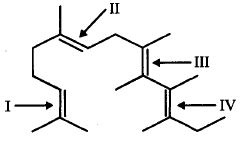
In the following structure, the double bonds are marked as $I, II, III$ and $IV$ Geometrical isomerism is not possible at site $(s)$
For a concentrated solution of a weak electrolyte ( $K _{ eq }=$ equilibrium constant) $A _2 B _3$ of concentration ' $c$ ', the degree of dissociation " $\alpha$ ' is
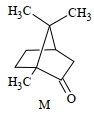
The total number of stereoisomers that can exist for $M$ is

$Image$

Which one of the following complexes is not expected to exhibit isomerism ?
Consider the following complex : $[Co(NH_3)_5CO_3]ClO_4$ The coordination  number, oxidation number, no. of $d-$ electrons and number of unpaired $d-$ electrons  on the metal are respectively