MCQ
Which of the following is a dimensional constant?
  • Gravitational constant
  • B
    Relative density
  • C
    Refractive index
  • D
    Poisson ratio

Answer

Correct option: A.
Gravitational constant
a
Gravitational constant also known as universal gravitational constant has a symbol $G$ and has a dimension $\left[ M ^{-1} L ^3 T ^{-2}\right]$ while others are dimensionless constant.

Need a full question paper?

Generate a complete, print-ready paper with questions like this in minutes — across 16+ boards, with answer keys.

Start Generating Free

Similar questions

Two friends $A$ and $B$ are waiting for another friend for tea. $A$ took the tea in a cup and mixed the cold milk and then waits. $B$ took the tea in the cup and then mixed the cold milk when the friend comes. Then the tea will be hotter in the cup of
When a hot liquid is mixed with a cold liquid, the temperature of the mixture:
  1. First decreases then becomes constant.
  2. First increases then becomes constant.
  3. Continuously increases.
  4. Is undefined for some time and then becomes nearly constant.
At a certain temperature for given wave length, the ratio of emissive power of a body to emissive power of black body in same circumstances is known as
If the earth rotates faster than its present speed, the weight of an object will
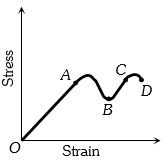
A graph is shown between stress and strain for a metal. The part in which Hooke's law holds good is
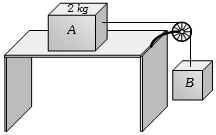
The coefficient of static friction, ${\mu _s},$ between block $A$ of mass $2\, kg$ and the table as shown in the figure is $0.2$. ........ $kg$ would be the maximum mass value of block $B$ so that the two blocks do not move. The string and the pulley are assumed to be smooth and massless. $(g = 10\,m/{s^2})$
Two balls are dropped from heights $h$ and $2h$ respectively from the earth surface. The ratio of time of these balls to reach the earth is
If the radius of a star is $R$ and it acts as a black body, what would be the temperature of the star, in which the rate of energy production is $Q$?

($\sigma$ stands for Stefan's constant)

The wavelength of ultrasonic waves in air is of the order of
A source of sound and listener are approaching each other with a speed of $40 m/s.$ The apparent frequency of note produced by the source is $400 \,cps$. Then, its true frequency (in $cps$) is (velocity of sound in air $= 360 m/s$)