MCQ
Which of the following is a gemdihalide
- A$C{H_3}.CHBr.CHBr.C{H_3}$
- B$C{H_2}Br.C{H_2}Br$
- C$CHBr = CHBr$
- ✓$C{H_3}CHB{r_2}$
$\mathop {C{H_3} - CHB{r_2}}\limits_{{\rm{Gemdihalide}}} $ $\mathop {\mathop {C{H_2}}\limits_{\mathop {|\,\,\,\,\,\,\,}\limits_{Br\,\,\,} } - \mathop {C{H_2}}\limits_{\mathop {|\,\,\,\,\,\,\,\,}\limits_{Br\,\,\,\,} } }\limits_{vic{\rm{ - }}{\rm{dihalide}}} $
Generate a complete, print-ready paper with questions like this in minutes — across 16+ boards, with answer keys.
$\mathrm{C}\mathrm{H}_{3} -\mathrm{C} \equiv \mathrm{CH} \xrightarrow[873\;K]{\text { red hot iron tube}} \mathrm{A}$
the number of sigma$(\sigma)$ bonds present in the product $A$ is
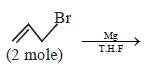
Statement $II :$ As the size of the elements $\mathrm{F}, \mathrm{Cl}, \mathrm{Br}, \mathrm{I}$ increases down the group, the bond strength of $\mathrm{HF}$, HCl, HBr and HI decreases and so the acid strength increases.
In the light of the above statements, choose the correct answer from the options given below.
$H_2 + F_2 \longrightarrow 2HF$
given that
Bond energy of $H-H$ bond $= 434\, kJ/mol$
Bond energy of $F-F$ bond $= 158\, kJ/mol$
Bond energy of $H-F$ bond $= 565\, kJ/mol$
.....$ kJ$
$(A)\, F^-, Na^+, Mg^{+2}$ $(B) \,Ni, Cu, Zn$
$(C)\, N^{-3}, Cs^+, H^-$ $(D)\, Li, He, Be^{+2}$