MCQ
Which of the following is a network solid?
  • $\mathrm{SO}_2 ($Solid$).$
  • B
    $I_2$.
  • C
    Diamond.
  • D
    $\mathrm{H}_2 \mathrm{O} ($Ice$).$

Answer

Correct option: A.
$\mathrm{SO}_2 ($Solid$).$
Diamond is a three$-$dimensional network solid in which each carbon atom is tetrahedral bonded with four carbon atoms.

Need a full question paper?

Generate a complete, print-ready paper with questions like this in minutes — across 16+ boards, with answer keys.

Start Generating Free

Similar questions

If $18\,gm$ of glucose $({C_6}{H_{12}}{O_6})$ is present in $1000\,gm$ of an aqueous solution of glucose, it is said to be ......... $molal$
The major product expected, when Phthalamide is treated with $NaOH,$ is
Mention catalyst in the following reaction$:\ \mathrm{KClO}_3 \rightarrow \mathrm{KCl}+\mathrm{O}_2$​
$6 -$ amino purine is:
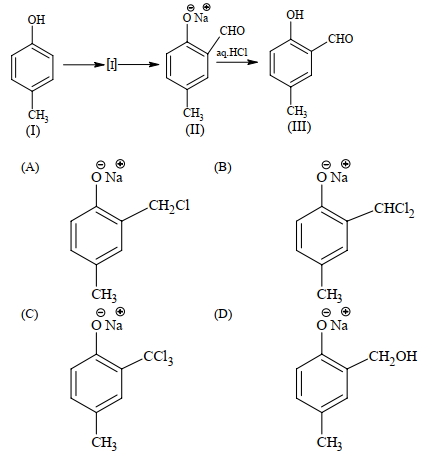
Reimer-Tiemann reaction introduces an aldehyde group, on to the aromatic ring of phenol, ortho to the hydroxyl group. This reaction involves electrophilic aromatic substitution. This is a general method for the synthesis of substituted salicyladehydes as depicted below.

$Image$

$1.$ Which one of the following reagents is used in the above reaction?

$(A)$ aq. $\mathrm{NaOH}+\mathrm{CH}_3 \mathrm{Cl}$

$(B)$ aq. $\mathrm{NaOH}+\mathrm{CH}_2 \mathrm{Cl}_2$

$(C)$ aq. $\mathrm{NaOH}+\mathrm{CHCl}_3$

$(D)$ aq. $\mathrm{NaOH}+\mathrm{CCl}_4$

$2.$ The electrophile in this reaction is

$(A)$ : $\mathrm{CHCl}$ $(B)$ ${ }^{+} \mathrm{CHCl}_2$

$(C)$ $\mathrm{CCl}_2$ $(D)$. $\mathrm{CCl}_3$

$3.$ The structure of the intermediate $I$ is

$Image$

Give the answer question $1, 2$ and $3.$
Glucose does not react with
Natural rubber is obtained as 'latex', which is a milky, white fluid from rubber trees. Latex is a:
When $40\,mL$ of $0.1\,N\,HCl$ and $20\,mL$ of $0.1\,M\,H_2SO_4$ are mixed together, the normality of the mixture will be
The difference between spin only magnetic moment values of $\left[ Co \left( H _{2} O \right)_{6}\right] Cl _{2}$ and $\left[ Cr \left( H _{2} O \right)_{6}\right] Cl _{3}$ is $....$
Identify the reactant $X$ and the product $Y$