MCQ
Which of the following is a primary halide?
- ✓Neohexyl chloride
- BSecondary butyl iodide
- CTertiary butyl bromide
- DIso-propyl iodide
e.g., $C{H_3} - O - {C_2}{H_5}\, + \,HI\,\xrightarrow{{373\,\,K}}C{H_3}I\, + \,{C_2}{H_5}OH$
The alkyl halide is formed from the smaller alkyl group.
However, in case of tertiary alkyl ether following reaction occurs.
$\mathop {C{H_3} - OC{{(C{H_3})}_3}}\limits_{ter - butyl\,\,methyl\,\,ether} + \,HI\,\xrightarrow{{373\,\,K}}$ ${(C{H_3})_3}C - I\, + \,C{H_3}OH$
The alkyl halide is formed from the tertiary alkyl group and the cleavage of such ethers occurs by $S_{N^1}$ mechanism as the product is controlled by the formation of more stable intermediate tertiary carbocation from orotonated ether.
Generate a complete, print-ready paper with questions like this in minutes — across 16+ boards, with answer keys.
$H _{2}+\frac{1}{2} O _{2} \rightarrow H _{2} O , \cdots \cdots( ii )$ $\Delta H =-\,287.3 \,kJ\,mol ^{-1}$
$2 CO _{2}+3 H _{2} O \rightarrow C _{2} H _{5} OH +3 O _{2} \cdots \cdots ( iii )$; $ \Delta H =1366.8 \,kJ\,mol ^{-1}$
Find the standard enthalpy of formation of $C _{2} H _{5} OH (1)$
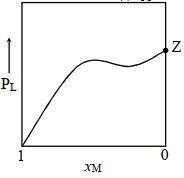
(image)
$[A]$ Attractive intermolecular interactions between $L-L$ in pure liquid $L$ and $M-M$ in pure liquid $M$ are stronger than those between $L-M$ when mixed in solution
$[B]$ The point $Z$ represents vapour pressure of pure liquid $M$ and Raoult's law is obeyed when $x_{L} \rightarrow 0$
$[C]$ The point $Z$ represents vapour pressure of pure liquid $L$ and Raoult's law is obeyed when $x_{\mathrm{L}} \rightarrow 1$
$[D]$ The point $Z$ represents vapour pressure of pure liquid $M$ and Raoult's law is obeyed from $x_{L}=0$ to $x_{L}=1$