MCQ
Which of the following is an chiral compound
  • A
    Hexane
  • B
    Methane
  • C
    $n-$butane
  • $2,3,4-$trimethyl hexane

Answer

Correct option: D.
$2,3,4-$trimethyl hexane
d
(d) $C{H_3} - C{H_2} - \mathop {\mathop {{\text{ }}C}\limits^| H - }\limits^{C{H_3}\,\,\,\,\,\,\,\,\,} \mathop {\mathop {{\text{ }}C}\limits^| H - }\limits^{C{H_3}\,\,\,\,\,\,\,\,\,} \mathop {\mathop {{\text{ }}C}\limits^| H - }\limits^{C{H_3}\,\,\,\,\,\,\,\,\,} C{H_3}$, it is a chiral compound.

Need a full question paper?

Generate a complete, print-ready paper with questions like this in minutes — across 16+ boards, with answer keys.
Start Generating Free

Similar questions

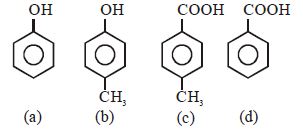
Correct order of acidic strength is ?
The number of non-polar molecules from the following is__________

$\mathrm{HF}, \mathrm{H}_2 \mathrm{O}, \mathrm{SO}_2, \mathrm{H}_2, \mathrm{CO}_2, \mathrm{CH}_4, \mathrm{NH}_3, \mathrm{HCl}, \mathrm{CHCl}_3, \mathrm{BF}_3$

Which one of the following substances consists of small discrete molecules
Which of the following is not a consequence of the Lanthanoid contraction?
Calculate $[H^+]$ at equivalent point between titration of $0.1\,M,\,25\,ml$ of weak acid $HA$ $(K_a = 10^{-5})$ with $0.05\,M\,NaOH$ solution.
The $pH $ at which maximum hydrate is present in an solution of oxaloacetic acid

$\begin{align}
   \begin{matrix}
   \,\,\,\,\,\,\,\,\,\,\,\,\,\,\,\,\,\,\,O\,\,\,\,\,\,\,O  \\
   \,\,\,\,\,\,\,\,\,\,\,\,\,\,\,\,\,\,\,||\,\,\,\,\,\,\,\,\,||  \\
   H-O-C-C-  \\
\end{matrix}\begin{matrix}
   O\,\,  \\
   ||\,\,\,  \\
   C{{H}_{2}}-C-O-H  \\
\end{matrix} \\ 
  p{{K}_{a}}=2.2\,\,\,\,\,\,\,\,\,\,\,\,\,\,\,\,p{{K}_{a}}=3.98 \\ 
\end{align}$

A moving particle may have wave motion, if
An aqueous solution contains $6\%$ and $4 \%$ by weight weak acid $(HA)$ and urea respectively. If depression in freezing point $ \frac{{13.6}}{3}\,^oC$. $K_a$ of $CH_3COOH$ will be [$K_f = 1.8 \,\,K-Kg/mole$]

(Molecular wight of $HA= 60, \,d_{solution} = 1\,gm/ml$)

Which of the following shape are not possible for possible value of  $' n'$ in $XeF_n$ molecule ?
The electron affinities of halogens are $F = 322$, $Cl = 349$, $Br = 324$, $I = 295\,kJ\,mo{l^{ - 1}}$. The higher value for $Cl$ as compared to that of $F$ is due to