MCQ
Which of the following is correct for light diverging from a point source?
  • The intensity decreases in proportion for the distance squared.
  • B
    The wavefront is parabolic.
  • C
    The intensity at the wavelength does not depend on the distance.
  • D
    None of these.

Answer

Correct option: A.
The intensity decreases in proportion for the distance squared.

A point source produces a spherical wavefront that moves in all the directions from the point.
Whereas the intensity at the wavelength is dependent on the distance and it follows the inverse square law. So, the intensity decreases with an increase in the distance from the source.

Need a full question paper?

Generate a complete, print-ready paper with questions like this in minutes — across 16+ boards, with answer keys.

Start Generating Free

Similar questions

One metallic sphere $A$ is given positive charge whereas another identical metallic sphere $B$ of exactly same mass as of $A$ is given equal amount of negative charge. Then
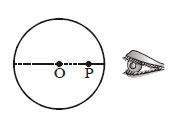
In the figure shown, $O$ is centre of the glass sphere. Spot $P$ on the sphere when viewed almost normally appears.
Angle of prism is $A$ and its one surface is silvered. Light rays falling at an angle of incidence 2 A on first surface return back through the same path after suffering reflection at second silvered surface. Refractive index of the material of prism is
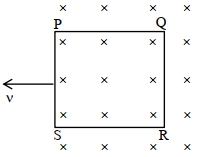
A square loop $\mathrm{PQRS}$ having $10$ turns, area $3.6 \times$ $10^{-3} \mathrm{~m}^2$ and resistance $100 \Omega$ is slowly and uniformly being pulled out of a uniform magnetic field of magnitude $\mathrm{B}=0.5 \mathrm{~T}$ as shown. Work done in pulling the loop out of the field in $1.0 \mathrm{~s}$ is. . . . . $\times 10^{-6} \mathrm{~J}$.
The heat produced by a 100 watt heater in 2 minute will be equal to
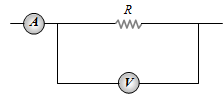
The ammeter A reads 2 A and the voltmeter V reads 20 V. the value of resistance R is (Assuming finite resistance's of ammeter and voltmeter)
Two electric bulbs ($60\,W$ and $100\,W$ respectively) are connected in series. The current passing through them is
A wire carrying a current $I$ along the positive $x$-axis has length $L$ It is kept in a magnetic field $\overrightarrow{ B }=(2 \hat{ i }+3 \hat{ j }-4 \hat{ k }) T$. The magnitude of the magnetic force acting on the wire is $..........IL$
The radius of electron's second stationary orbit in Bohr's atom is $R$. The radius of $3 rd$ orbit will be $.........R$
The motion of a particle is given by $\text{x = A}\sin\omega\text{t+B}\cos\omega\text{t}.$ The motion of the particle is: