MCQ
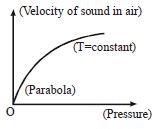
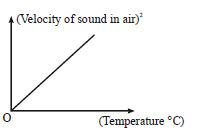
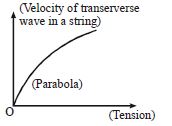
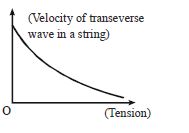
Which of the following is $CORRECT$
  • A

  • B


  • D

Answer

Correct option: C.

c
Velocity of sound in air $\left( V \right) = \sqrt {\frac{{\gamma RT}}{M}} $

$ \Rightarrow {V^2}\alpha T$        (in kelvin)

not ${V^2}\alpha T$ (in ${\,^0}C$)

Hence $(B)$ is incorrect.

velocity of transverse wave in nastring 

$V = \sqrt {\frac{T}{\mu }}  = {V^2}\alpha T$

Need a full question paper?

Generate a complete, print-ready paper with questions like this in minutes — across 16+ boards, with answer keys.
Start Generating Free

Similar questions

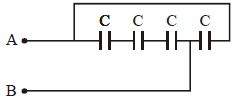
The equivalent capacitance between $A$ and $B$ is
A certain amount of current when flowing in a properly set tangent galvanometer, produces a deflection of $ 45°.$  If the current be reduced by a factor of $\sqrt 3 $, the deflection would
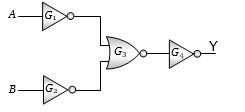
The combination of gates shown below produces
A circular disc of mass $2 \,kg$ and radius $10 \,cm$ rolls without slipping with a speed $2 \,m / s$. The total kinetic energy of disc is .......... $J$
A plane electromagnetic wave of wavelength $\lambda $ has an intensity $I.$  It is propagating along the positive $Y-$  direction. The allowed expressions for the electric and magnetic fields are given by
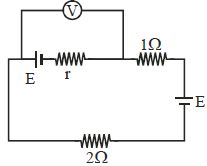
In the given circuit reading of ideal voltmeter is $\frac{E}{2}$ then internal resistance of cell is ............. $\Omega$
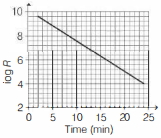
The graph shows the $\log$ of activity $\log R$ of a radioactive material as a function of time $t$ in minutes.The half-life (in minute) for the decay is closest to
The relative uncertainty in the period of a sateilite orbiting around the earth is $10^{-2}$. If the relative uncertainty in the radius of the orbit is negligible, the relative uncertainty in the mass of the earth is
A photon, an electron and a uranium nucleus all have the same wavelength. The one with the most energy
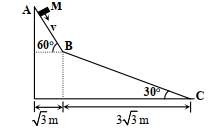
A small block of mass $M$ moves on a frictionless surface of an inclined plane, as shown in figure. The angle of the incline suddenly changes from $60^{\circ}$ to $30^{\circ}$ at point $\mathrm{B}$. The block is initially at rest at $A$. Assume that collisions between the block and the incline are totally inelastic $\left(\mathrm{g}=10 \mathrm{~m} / \mathrm{s}^2\right)$.

Figure: $Image$

$1.$ The speed of the block at point $B$ immediately after it strikes the second incline is

$(A)$ $\sqrt{60} \mathrm{~m} / \mathrm{s}$ $(B)$ $\sqrt{45} \mathrm{~m} / \mathrm{s}$

$(C)$ $\sqrt{30} \mathrm{~m} / \mathrm{s}$ $(D)$ $\sqrt{15} \mathrm{~m} / \mathrm{s}$

$2.$ The speed of the block at point $\mathrm{C}$, immediately before it leaves the second incline is

$(A)$ $\sqrt{120} \mathrm{~m} / \mathrm{s}$ $(B)$ $\sqrt{105} \mathrm{~m} / \mathrm{s}$

$(C)$ $\sqrt{90} \mathrm{~m} / \mathrm{s}$ $(D)$ $\sqrt{75} \mathrm{~m} / \mathrm{s}$

$3.$ If collision between the block and the incline is completely elastic, then the vertical (upward) component of the velocity of the block at point $B$, immediately after it strikes the second incline is

$(A)$ $\sqrt{30} \mathrm{~m} / \mathrm{s}$ $(B)$ $\sqrt{15} \mathrm{~m} / \mathrm{s}$

$(C)$ 0 $(D)$ $-\sqrt{15} \mathrm{~m} / \mathrm{s}$

Give the answer question $1,2$ and $3.$