MCQ
Which of the following is correct
  • $10\,^oC$ raise in tempeature lead to increase in rate of reaction by $2$ to $3$ times
  • B
    $\Delta H$ of reaction depends on catalyst
  • C
    a zero order reaction may be elementary
  • D
    half life of every reaction is constant

Answer

Correct option: A.
$10\,^oC$ raise in tempeature lead to increase in rate of reaction by $2$ to $3$ times
a

Need a full question paper?

Generate a complete, print-ready paper with questions like this in minutes — across 16+ boards, with answer keys.

Start Generating Free

Similar questions

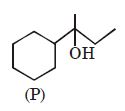
Which of the following option will not produce $(P)$ as major product on reaction with dil. $H_2SO_4$ ?
On passing the current in water voltameter, the hydrogen
In the diazotization of aryl amines with sodium nitrite and hydrochloric acid, an excess of hydrochloric acid is used primarily to :
In a cell, the following reactions take place

$Fe ^{2+} \rightarrow Fe ^{3+} + e ^{-} \quad E _{ Fe ^{3+} / Fe ^{2+}}=0.77 \,V$

$2 I ^{-} \rightarrow I _{2}+2 e ^{-} \quad E _{ I _{2} / I ^{-}}^{0}=0.54 \,V$

The standard electrode potential for the spontaneous reaction in the cell is $x \times 10^{-2} \,V 298$ $K$. The value of $x$ is .... (Nearest Integer)

Which will not give purple colour with ninhydrin
Which one of the following statements is correct?
For the following electrochemical cell at $298 \mathrm{~K}$,

$\mathrm{Pt}(s) \mid \mathrm{H}_2(g, 1 \text { bar })\left|\mathrm{H}^{+}(a q, 1 \mathrm{M}) \| \mathrm{M}^{4+}(a q), \mathrm{M}^{2+}(a q)\right| \mathrm{Pt}(s)$

$E_{\text {cell }}=0.092 \mathrm{~V} \text { when } \frac{\left[\mathrm{M}^{2+}(a q)\right]}{\left[\mathrm{M}^{4+}(a q)\right]}=10^x$

Given : $ E_{\mathrm{M}^4 / \mathrm{M}^{2+}}^0=0.151 \mathrm{~V} ; 2.303 \frac{R T}{F}=0.059 \mathrm{~V}$

The value of $x$ is

Given below are two statements:

Statement $I$: The boiling point of hydrides of Group $16$ elements follow the order

$\mathrm{H}_2 \mathrm{O}>\mathrm{H}_2 \mathrm{Te}>\mathrm{H}_2 \mathrm{Se}>\mathrm{H}_2 \mathrm{~S}$.

Statement $II$: On the basis of molecular mass, $\mathrm{H}_2 \mathrm{O}$ is expected to have lower boiling point than the othe members of the group but due to the presence of extensive $\mathrm{H}$-bonding in $\mathrm{H}_2 \mathrm{O}$, it has higher boiling point.

In the light of the above statements, choose the correct answer from the options given below:
Plotting $1 / \Lambda_{\mathrm{m}}$ against $\mathrm{c} \Lambda_{\mathrm{m}}$ for aqueous solutions of a monobasic weak acid ($HX$) resulted in a straight line with $y$-axis intercept of $\mathrm{P}$ and slope of $S$. The ratio $\mathrm{P} / \mathrm{S}$ is

$\left[\Lambda_{\mathrm{m}}=\right.$ molar conductivity

$\Lambda_{\mathrm{m}}^{\circ}=$ limiting molar conductivity

$\mathrm{c}=$ molar concentration

$\mathrm{K}_{\mathrm{a}}=$ dissociation constant of $\mathrm{HX}$ ]

The major products obtained from the following sequence of reactions are

$(CH_3)_2CHCH_2N(CH_2CH_3)_2 \xrightarrow{C{{H}_{3}}I}\xrightarrow[{{H}_{2}}O]{A{{g}_{2}}O}\xrightarrow{heat}$  products