MCQ
Which of the following is correct
  • A
    $H_2(g)+I_2(g) \to 2HI(g)$                  $\Delta H\,>\,\Delta U$
  • B
    $N_2(g)+3H_2(g) \to 2NH_3(g)$           $\Delta H\,>\,\Delta U$
  • $2SO_3(g)\to 2SO_2(g)+O_2(g)$          $\Delta H\,>\,\Delta U$
  • D
    $H_2O(g) \to H_2O(s)$                             $\Delta H\,>\,\Delta U$
Answer

Correct option: C.
$2SO_3(g)\to 2SO_2(g)+O_2(g)$          $\Delta H\,>\,\Delta U$
c

Need a full question paper?

Generate a complete, print-ready paper with questions like this in minutes — across 16+ boards, with answer keys.

Start Generating Free

Similar questions

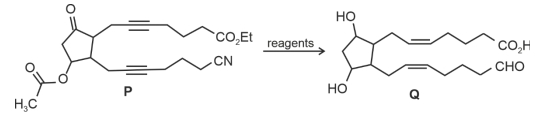
The option($s$) with correct sequence of reagents for the conversion of $P$ to $Q$ is(are)

$(A) i)$ Lindlar's catalyst, $H _2$; $ii$) $SnCl _2 / HCl$; iii) $NaBH _4$; iv) $H _3 O ^{+}$

$(B) i)$ Lindlar's catalyst, $H _2$; $ii$) $H _3 O ^{+}; iii)$ $SnCl _2 / HCl$; iv) $NaBH _4$

$(C) i)$ $NaBH _4; ii)$ $SnCl _2 / HCl; $iii$)$ $H _3 O ^{+}; iv)$ Lindlar's catalyst, $H _2$

$(D) i)$ Lindlar's catalyst, $H _2$; $ii$) $NaBH _4; iii)$ $SnCl _2 / HCl; iv)$ $H _3 O ^{+}$

One mole of an ideal gas is allowed to expand reversibly and adiabatically from a temperature of ${27\,^o}C$. If the work done during the process is $3 \,kJ, $ the final temperature will be equal to $({C_v} = 20\,J\,{K^{ - 1}})$
What is the electronic arrangement of G?
The frequency of radiation emitted when the electron falls from $n = 4$ to $n = 1$ in a hydrogen atom will be
(Given $h = 6.625 × 10^{-34} \,Js$) :-
For the reaction $SO_2(g) + \frac{1}{2} O_2(g) \rightleftharpoons SO_3(g),$ if $K_P = K_C ( RT)^x$ where the symbols have usual meaning then the value of $x$ is (assuming ideality) :
The number of radial nodes for 3p orbital is ______.
Which of the following compound is not resonance stabilized ?
Which of the following compounds is/are amphoteric in nature?
In the periodic table, the element with atomic number $16$ will be placed in the group
Consider the following equations:

$2 Fe ^{2+}+ H _{2} O _{2} \rightarrow x A + y B$

(in basic medium)

$2 MnO _{4}^{-}+6 H ^{+}+5 H _{2} O _{2} \rightarrow x ^{\prime} C + y ^{\prime} D + z ^{\prime} E$

(in acidic medium)

The sum of the stoichiometric coefficients $x , y , x ^{\prime}, y ^{\prime}$ and $z ^{\prime}$ for products $A , B , C , D$ and $E ,$ respectively, is............