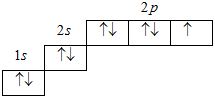
MCQ
Which of the following is dependent on temperature ?
- ✓Molarity
- BMole fraction
- CWeight percentage
- DMolality
Generate a complete, print-ready paper with questions like this in minutes — across 16+ boards, with answer keys.
| Column - $I$ | Column - $II$ |
| $(a)$ $XeF _{2}$ | $(i)$ Van Arkel method |
| $(b)$ $XeF _{4}$ | $(ii)$ Linear |
| $(c)$ $XeO _{3}$ | $(iii)$ Square pyramidal |
| $(d)$ $XeOF_{4}$ | $(iv)$ Pyramidal |

$(1)$ $C{H_3}CH = CHC{H_2}C{H_3}$ $ \xrightarrow{HBr} $
$(2)$ $C{H_3}C{H_2}CH = C{H_2}$ $ \xrightarrow{HBr} $
$(3)$ $C{H_3}CH = CHC{H_3}$ $ \xrightarrow{Br_2} $
$(4)$ $C{H_3}C{H_2}CH = C{H_2}\mathop {}\limits_{{\rm{}}} $ $ \xrightarrow[Proxide]{HBr} $
$(1)$ $\begin{array}{*{20}{c}}
{C{H_3}CH = C - C{H_3}} \\
{\,\,\,\,\,\,\,\,\,\,|} \\
{\,\,\,\,\,\,\,\,\,\,\,\,\,\,\,\,C{H_3}}
\end{array}$
$(2)$ $C{H_3}CH = CHC{H_3}$
$(3)$ $\mathop {C{H_3}C}\limits^{\begin{subarray}{l}
\,\,\,\,\,\,\,\,{\begin{array}{*{20}{c}}
{}&H
\end{array}} \\
\,\,\,\,\,\,\,\,\,\,\,\,\,\,|
\end{subarray} } = CHC{H_2}C{H_3}$
$(4)$ $\begin{array}{*{20}{c}}
{C{H_3}C = C - C{H_3}} \\
{\,\,\,\,\,\,\,|\,\,\,\,\,\,\,\,\,\,\,\,|\,\,\,\,\,\,\,\,\,\,\,\,\,} \\
{\,\,\,\,\,\,\,\,\,\,\,\,\,C{H_{3\,\,}}\,\,C{H_3}\,\,\,\,\,\,\,\,\,\,\,\,\,\,\,\,}
\end{array}$
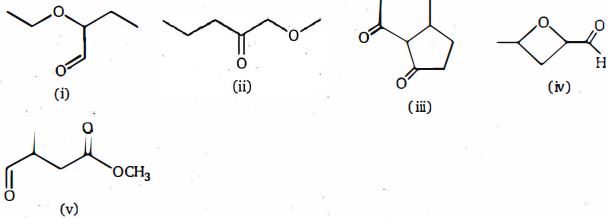
| $H - H$ bond energy | $:\, 431.37 \,kJ\, mol^{-1}$ |
| $C= C$ bond energy | $:\, 606.10\, kJ \,mol^{-1}$ |
| $C - C$ bond energy | $:\, 336.49\, kJ\, mol^{-1}$ |
| $C - H$ bond energy | $:\, 410.50\, kJ\, mol^{-1}$ |
Enthalpy for the reaction,
$\begin{array}{*{20}{c}}
{H\,\,\,\,H} \\
{|\,\,\,\,\,\,\,\,|} \\
{C = C} \\
{|\,\,\,\,\,\,\,\,\,|} \\
{H\,\,\,\,H}
\end{array}\, + \,H - H\, \to \,\begin{array}{*{20}{c}}
{H\,\,\,\,H} \\
{|\,\,\,\,\,\,\,\,|} \\
{H - C - C - H} \\
{|\,\,\,\,\,\,\,\,\,|} \\
{H\,\,\,\,H}
\end{array}\,$
will be .............. $\mathrm{kJ \,mol}^{-1}$