MCQ
Which of the following is isoelectronic with carbon atom
- A$N{a^ + }$
- B$A{l^{3 + }}$
- C${O^{2 - }}$
- ✓${N^ + }$
${N^ + } = 1{s^2}\,2{s^2}2{p^2}$
$C = \,\,1{s^2}\,2{s^2}2{p^2}.$
Generate a complete, print-ready paper with questions like this in minutes — across 16+ boards, with answer keys.
$A^+/A = \,-\,2.93\, Volt$, $B^+/B = 0.80\,V$
$C^{+2}/C = \,-\,2.37\, Volt$, $D^{+3}/D = \,-\,0.74\,V$
Increasing order of reducing power of these metals
If $T_1=2 T_2$ and $\left(\Delta G_2^{\Theta}-\Delta G_1^{\varphi}\right)=R T_2 \ln x$, then the value of $x$ is. . . . .
$\left[\Delta G_1^\theta\right.$ and $\Delta G_2^\theta$ are standard Gibb's free energy change for the reaction at temperatures $T_1$ and $T_2$, respectively.]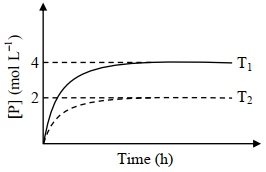
[Given : atomic mass of $Cr =52$ $amu$ and $Cl =35\, amu ]$