MCQ
Which of the following is Lewis acid
- ✓$B{F_3}$
- B$C{l^ - }$
- C${H_2}O$
- D$N{H_3}$
Generate a complete, print-ready paper with questions like this in minutes — across 16+ boards, with answer keys.
$SO{{_{3}^{2-}}_{\left( aq. \right)}}+{{H}_{2}}{{O}_{\left( l \right)}}\to SO{{_{4}^{2-}}_{\left( aq. \right)}}+2{{H}^{+}}_{\left( aq. \right)}+2{{H}^{+}}_{\left( aq. \right)}+2{{e}^{-}}$
If the oxidation number of metal in the salt was $+3$, what would be the new oxidation number of metal?
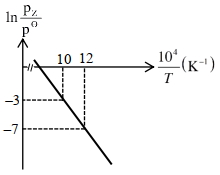
(Given, $\frac{ d (\ln K )}{ d \left(\frac{1}{T}\right)}=-\frac{\Delta H^{\ominus}}{ R }$, where the equilibrium constant, $K =\frac{ p _{ z }}{ p ^{\ominus}}$ and the gas constant, $R =8.314$ $\left.J K ^{-1} mol ^{-1}\right)$
($1$) The value of standard enthalpy, $\Delta H ^{\ominus}$ (in $kJ mol ^{-1}$ ) for the reaction is. . . . . . .
($2$) The value of $\Delta S^{\ominus}$ (in $J K ^{-1} mol ^{-1}$ ) for the given reaction, at $1000 K$ is. . . . . .
Give the answer or quetin ($1$) and ($2$)