MCQ
Which of the following is not a correct statement for primary aliphatic amines?
  • The intermolecular association in primary amines is less than the intermolecular association in secondary amines.
  • B
    Primary amines on treating with nitrous acid solution form corresponding alcohols except methyl amine.
  • C
    Primary amines are less basic than the secondary amines.
  • D
    Primary amines can be prepared by the Gabriel phthalimide synthesis.
Answer

Correct option: A.
The intermolecular association in primary amines is less than the intermolecular association in secondary amines.
a
The intermolecular association is more prominent in case of primary amines as compared to secondary, due to the availability of two hydrogen atom.

Need a full question paper?

Generate a complete, print-ready paper with questions like this in minutes — across 16+ boards, with answer keys.

Start Generating Free

Similar questions

$80$ mole percent of $MgCl _2$ is dissociated in aqueous solution. The vapour pressure of $1.0$ molal aqueous solution of $MgCl _2$ at $38^{\circ} C$ is $.........\,mm\,Hg$. (Nearest integer)Given : Vapour pressure of water at $38^{\circ} C$ is $50\,mm\,Hg$
Determine the degree of association (polymerization) for the reaction in aqueous solution $6HCHO  \rightleftharpoons  C_6H_{12}O_6$ If observed (mean) molar mass of $HCHO$ and $C_6H_{12}O_6$ is $150$
Which of the following conditions regarding a chemical process ensures its spontaneity at all temperature ?
Equimolar solutions of the following substances were prepared separately. Which one of these will record the highest $pH$ value?
$C _{12} H _{22} O _{11}+ H _{2} O \stackrel{\text { Enzyme A }}{\longrightarrow} C _{6} H _{12} O _{6}+ C _{6} H _{12} O _{6}$

Sucrose $\quad$ $\quad$ $\quad$ $\quad$ $\quad$ $\quad$ $\quad$ Glucose $\quad$ Fructose

$C _{6} H _{12} O _{6} \stackrel{\text { Enzyme B }}{\longrightarrow} 2 C _{2} H _{5} OH +2 CO _{2}$

Glucose

In the above reactions, the enzyme $A$ and enzyme $B$ respectively are :-

For the Galvanic cell :

$Ag(s)\,\,|\,\,A{g_2}{C_2}{O_4}(s)\,\,|\,\,{C_2}O_4^{2 - }(0.02\,M)\,\,||\,\,A{g^ + }(0.5\,M)\,\,|\,\,Ag(s)$

$EMF$ of cell is $0.264\ V$ at $25\,^oC$ . $K_{sp}$ of $Ag_2C_2O_4(s)$ is

$\left[ {Given = \frac{{2.303 \times 8.314 \times 298}}{{96500}} = \frac{{2.303RT}}{F} = 0.06,\,\log 2 = 0.3} \right]$

Sodium chloride easily dissolves in water. This is because
Limiting molar conductivity of $NH_4OH$

$[i.e.\, \Lambda ^o_{m(NH_4OH)}]$ is equal to

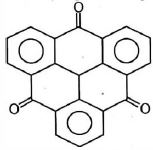
Which of the following is correct for the given compound?
The photoelectric current from Na (work function, $\left. w _{0}=2.3\, eV \right)$ is stopped by the output voltage of the cell 

$Pt ( s )\left| H _{2}( g , 1 bar )\right| HCl ( aq \cdot, pH =1)| AgCl ( s )| Ag ( s )$

The $pH$ of aq. HCl required to stop the photoelectric current from $K \left( w _{0}=2.25 eV \right),$ all other conditions remaining the same, is..........$\times 10^{-2}$ (to the nearest integer).

Given, $2.303 \frac{ RT }{ F }=0.06 V ; E _{ AgC1|Ag|C ^{-}}^{0}=0.22\, V$