MCQ
Which of the following is not a reducing agent
  • A
    $NaN{O_2}$
  • $NaN{O_3}$
  • C
    $HI$
  • D
    $SnC{l_2}$

Answer

Correct option: B.
$NaN{O_3}$
(b) $NaN{O_2}$, $SnC{l_2}$ and $HI$ have reducing and oxidizing properties but $NaN{O_3}$ have only oxidizing property.

Need a full question paper?

Generate a complete, print-ready paper with questions like this in minutes — across 16+ boards, with answer keys.

Start Generating Free

Similar questions

For the ions $Zn ^{2+}, \,Ni ^{2+}$ and $Cr ^{3+}$ which among the following statements is correct ?

(Atomic number of $Zn =30,\,Ni =28$ and $Cr =24$ )

$(I)$ $1,2-$dihydroxy benzene

$(II)$ $1,3-$dihydroxy benzene

$(III)$ $1,4-$dihydroxy benzene

$(IV)$ Hydroxy benzene

The increasing order of boiling points of above mentioned alcohols is
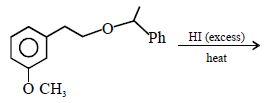
.
The entropy change associated with the conversion of $1\,kg$ of ice at $273\,K$ to water vapours at $383\,K$ is: (Specific heat of water liquid and water vapours are $4.2\,kJ\,K^{-1}\,kg^{-1}$ and $2.0\,kJ\,K^{-1}\,kg^{-1},$ heat of liquid fusion and vapourisation of water are $334\,kJ\,kg^{-1}$ and $2491\,kJ\,kg^{-1},$ respectively) $(log\,273 = 2.436,\,log\,373 = 2.572,\,log\,383 = 2.583)$ ......$kJ\,K^{-1}\,kg^{-1}$
Successive alkanes differ by
Which of the following expression is true for an ideal gas.
$STATEMENT-1$: The geometrical isomers of the complex $\left[\mathrm{M}\left(\mathrm{NH}_3\right)_4 \mathrm{Cl}_2\right]$ are optically inactive. and

$STATEMENT-2$: Both geometrical isomers of the complex $\left[\mathrm{M}\left(\mathrm{NH}_3\right)_4 \mathrm{Cl}_2\right]$ possess axis of symmetry.

How many bridging oxygen atoms are present in $P_4O_{10}$ ?
Intermolecular forces are forces of attraction and repulsion between interacting particles that will include:
A. dipole-dipole forces.
B. dipole-induced dipole forces,
C. Metallic bonding
D. Covalent bonding
E. London dispersion forces
Choose the most appropriate answer from the options given below:
Which of the following organometallic compound is $\sigma $ and $\pi $ bonded