MCQ
Which of the following is not hydrolysed ?
  • A
    $AsCl_3$
  • B
    $PF_3$
  • C
    $SbCl_3$
  • $NF_3$

Answer

Correct option: D.
$NF_3$
d
$NF_3$ central atom does not have vaccant orbital.

Need a full question paper?

Generate a complete, print-ready paper with questions like this in minutes — across 16+ boards, with answer keys.
Start Generating Free

Similar questions

The deep blue colour produced on adding excess of ammonia to copper sulphate is due to presence of
N − Ethyl pthalimide on hydrolysis gives:
Which of the following statement is correct
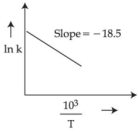
The rate constants for decomposition of acetaldehyde have been measured over the temperature range $700-1000\, K$. The data has been analysed by plotting $ln\, k\,$vs$\,\frac{10^{3}}{ T }$ graph. The value of activation energy for the reaction is $......\,kJ mol ^{-1}$. (Nearest integer) (Given : $R =8.31\, J \,K ^{-1} \,mol ^{-1}$ )
A chemist wants to determine the molecular geometry of the $[CoCl_4]^{2-}$ ion. Which of the following gives the best suggestion for a measurement and for the interpretation of that measurement ?
When alkyl halide is heated with dry $A{g_2}O$, it produces
In the following reaction

$\begin{matrix}
   \begin{matrix}
   C{{H}_{3}}\,\,\,\,\,\,\,\, \,\, \\
   |\,\,\,\,\,\,\,\,\,\,\,\,\,\,\,\,\,\,  \\
\end{matrix}  \\
   C{{H}_{3}}-C-CH=C{{H}_{2}}  \\
   |\,\,\,\,\,\,\,\,\,\,\,\,\,\,\,\,\,\,  \\
   C{{H}_{3}}\,\,\,\,\,\,\,\, \,\,\,\, \\
\end{matrix}\,$ $\xrightarrow{{{H}_{2}}O/{{H}^{\oplus }}}$ $\underset{Major\,\,product}{\mathop{A}}\,$ $+$ $\underset{Major\,\,product}{\mathop{B}}\,$

The major product is

Which transition element does not exhibit variab oxidation states?
$\begin{matrix}
   Ph-CH-OH  \\
   |\,\,\,\,\,\,  \\
   \,\,C{{H}_{3}}  \\
\end{matrix}$$\xrightarrow{{PCC}}A\xrightarrow[{(ii)\,\,{H^ \oplus }/\,\Delta }]{{(i)\,\,N{H_2}OH}}B + C$

In the given reaction sequence $B$ and $C$ are :

Which of the following will show optical isomers?

$(I)$ cis $- [Co(NH_3)_2(en)_2]^{3+}$      $(II)$ trans $-[IrCl_2(C_2O_4)_2]^{3-}$
$(III)\, [Rh(en)_3]^{3+}$                         $(IV)$ cis $-[Ir(H_2O)_3Cl_3$