MCQ
Which of the following is not isoelectronic
  • A
    $N{a^ + }$
  • B
    $M{g^{2 + }}$
  • C
    ${O^{2 - }}$
  • $C{l^ - }$

Answer

Correct option: D.
$C{l^ - }$
d
(d) $N{a^ + }$$ = 1{s^2}\,2{s^2}\,2{p^6}$

$Mg++$ $ = 1{s^2}\,2{s^2}\,2{p^6}$

${O^{2 - }}$$ = 1{s^2}\,2{s^2}\,2{p^6}$

$C{l^ - }$$ = 1{s^2}\,2{s^2}\,2{p^6}3{s^2}3{p^6}$

Need a full question paper?

Generate a complete, print-ready paper with questions like this in minutes — across 16+ boards, with answer keys.
Start Generating Free

Similar questions

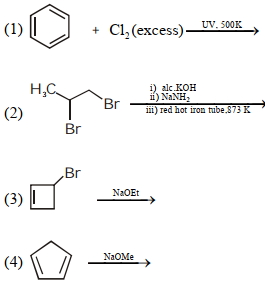
Choose the correct option($s$) that give($s$) an aromatic compound as the major product.
The ortho/para directing group among the following is
Which of the following order can't be explained by back bonding ?
In which of the following combination, is buffer action expected ?
$(a)\, NH_4OH + NH_4Cl$
$(b)\, HCl + NaCl$
$(c)\, NH_4OH + HCl$ in $2 : 1$ mole ratio
Select the correct answer using the code given below
The number of ions from the following that are expected to behave as oxidising agent is:
$Sn ^{4+}, Sn ^{2+}, Pb ^{2+}, Tl ^{3+}, Pb ^{4+}, Tl ^{+}$
Reaction of $B{r_2}$ on ethylene in presence of $NaCl$ gives
Ethylene has high b.p. and high vapour pressure at ${100\,^o}C$ and does not dissolve in water. Hence ethylene is separated by this method
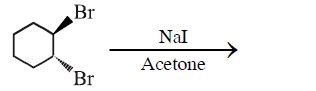
The major product for in the reaction
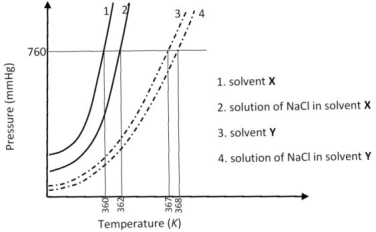
The plot given below shows $P - T$ curves (where $P$ is the pressure and $T$ is the temperature) for two solvents $X$ and $Y$ and isomolal solutions of $NaCl$ in these solvents. $NaCl$ completely dissociates in both the solvents.

On addition of equal number of moles of a non-volatile solute $S$ in equal amount (in $kg$ ) of these solvents, the elevation of boiling point of solvent $X$ is three times that of solvent $Y$. Solute $S$ is known to undergo dimerization in these solvents. If the degree of dimerization is $0.7$ in solvent $Y$, the degree of dimerization in solvent $X$ is. . . . . . .
$EMF$ of following concentration cell will be ............. $\mathrm{V}$

 ${\text{C}}{{\text{l}}_2}\,{\text{(1}}\,{\text{atm) |}}\,{\text{C}}{{\text{l}}^ - }\,{\text{(1}}\,\,{\text{M)}}\,{\text{|| C}}{{\text{l}}^ - }\,(0.1\,M)\,|\,C{l_2}\,(2\,atm)$