MCQ
Which of the following is not paramagnetic
  • ${S^{ - 2}}$
  • B
    ${N_2}^ - $
  • C
    $O_2^ - $
  • D
    $NO$

Answer

Correct option: A.
${S^{ - 2}}$
(a) ${S^{ - 2}}$ have all paired electrons so it is diamagnetic.

Need a full question paper?

Generate a complete, print-ready paper with questions like this in minutes — across 16+ boards, with answer keys.

Start Generating Free

Similar questions

Which of the following is an uncommon hydrolysis product of $XeF_2$ and $XeF_4$?
The compound formed on heating chlorobenzene with chloral in the presence of concentrated sulphuric acid, is
$C _{6} H _{12} O _{6} \stackrel{\text { Zymase }}{\longrightarrow} A \underset{\Delta}{\stackrel{ Na O I }{\longrightarrow}} B + CHI _{3}$

The number of carbon atoms present in the product $B$ is $.....$

${H_2}{O_{\left( g \right)}} + {C_{\left( s \right)}} \to C{O_{\left( g \right)}} + {H_2}\left( g \right)\,;\,\Delta H = 100\,kJ$

$C{O_{\left( g \right)}} + \frac{1}{2}{O_{2\left( g \right)}} \to C{O_{2\left( g \right)}}\,;\,\Delta H =  - 300\,kJ$

${H_2}_{\left( g \right)} + \frac{1}{2}{O_2}_{\left( g \right)} \to {H_2}{O_{\left( g \right)}}\,;\,\Delta H =  - 250\,kJ$

$C_{(s)} + O_{2(g)} \to  CO_{2(g)} ; \Delta H = -x\, kJ$

The value of $x$ will be

The value of $\Delta H$ for the reaction $X_{2(g)} + 4Y_{2(g)} \rightleftharpoons XY_{4(g)}$ is less than zero. Formation of $XY_{4(g)}$ will be favoured at
Which of the following is always negative for exothermic reaction?
The photoelectric current from Na (work function, $\left. w _{0}=2.3\, eV \right)$ is stopped by the output voltage of the cell 

$Pt ( s )\left| H _{2}( g , 1 bar )\right| HCl ( aq \cdot, pH =1)| AgCl ( s )| Ag ( s )$

The $pH$ of aq. HCl required to stop the photoelectric current from $K \left( w _{0}=2.25 eV \right),$ all other conditions remaining the same, is..........$\times 10^{-2}$ (to the nearest integer).

Given, $2.303 \frac{ RT }{ F }=0.06 V ; E _{ AgC1|Ag|C ^{-}}^{0}=0.22\, V$
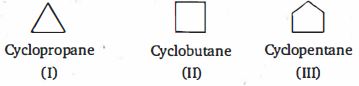
The correct order of heats of combustion of above compounds is
When $4d$ orbital is complete, the newly entering electrons goes in to
Diethyl ether and air gives ether hydroperoxide. The mechanism of the reaction is